Category: Blog

Your blog category

  • ![HERO] Can You Really Flip Houses with Bad Credit? Find Out How to Fund a House Flip Here (https://cdn.marblism.com/KZeohYvNj4a.webp)

    The bad-credit myth is a wealth leak—here’s why it keeps women stuck

    Bad credit does not end investing careers. What ends them is accepting the bank’s definition of “ready.”

    When you’re told a low score disqualifies you from flipping houses, the message underneath is more damaging than the denial itself: wait on the sidelines until you’re “approved.” That belief traps ambitious women in Homeowner Energy—where every decision is filtered through personal worthiness, personal paperwork, and personal permission.

    House flipping is not a consumer purchase. It’s a financial project with an asset, a timeline, a risk profile, and a profit target. Projects are funded differently than people. The moment you shift into Investor Authority, the question changes from “Do they like my credit?” to “Is this a controlled opportunity with protected margins?”


    The real problem: you’re being evaluated like a borrower, not an operator

    Traditional lenders are designed to reduce uncertainty. They want predictable income, clean credit, long histories, and a slow process. That model isn’t “wrong”—it’s just not built for the speed and complexity of investment projects.

    If you approach flipping with Homeowner Energy, you unintentionally reinforce that model:

    • You over-focus on your personal score instead of the deal structure
    • You treat capital as “approval,” not as a business input to be negotiated
    • You hesitate to pursue opportunities until conditions feel perfect

    Investor Authority refuses that frame. An investor understands that a deal is a package: acquisition, rehab, carry costs, exit strategy, and downside protection. Funding is the tool that makes that package executable.

    This is why women with mediocre credit still close projects: they don’t rely on one lane. They build credibility through structure.


    The highest risk isn’t rejection—it’s stagnation

    Bad credit becomes dangerous when it turns into delay.

    Stagnation has a real price tag in real estate:

    • Equity loss: the best deals are bought by the people willing to move first
    • Experience loss: the learning curve doesn’t reward intention; it rewards execution
    • Network loss: lenders, contractors, agents, and partners trust operators in motion
    • Confidence loss: every month on the sidelines strengthens the story that you “can’t”

    And the market doesn’t pause while you wait for a score to recover. Neighborhoods shift. Inventory cycles. Interest rates move. Meanwhile, your future portfolio stays imaginary.

    That’s not a credit problem. That’s a strategy problem.


    Investor Authority: what serious funding sources actually want to see

    When investors talk about funding, they’re not looking for someone “deserving.” They’re looking for someone who thinks like a Profit Protector—a decision-maker who can defend the numbers and manage the project.

    Investor Authority shows up in professional signals:

    Clear deal logic (not vibes)

    You can articulate why the property works, where the margin comes from, and what assumptions you refuse to make.

    Downside awareness (not optimism)

    You acknowledge the friction points—permits, labor delays, materials inflation, appraisal risk—and you still show how the deal survives reality.

    Exit clarity (not hope)

    You’re not relying on a single outcome. You know what the primary exit is and what happens if the market softens.

    That posture changes everything. It’s how you get taken seriously—regardless of whether your credit is pristine.


    Creative funding is a system—build a capital stack that protects you

    Creative funding is not a last-minute scramble. High-level operators treat it as a system: a capital stack designed to keep the project funded while protecting profit, timeline, and control.

    A strong stack creates Market Immunity because you aren’t dependent on one institution’s definition of “acceptable.” When one lane tightens, you don’t stop—you restructure.

    Without giving a step-by-step playbook, here’s the professional framing:

    Asset-based capital

    Funding that centers the property and the plan. The asset is the anchor, and the underwriting leans heavily on the deal’s margin and risk controls—not just your score.

    Relationship-based capital

    Private capital and investor relationships that fund operators with clear standards. The credibility comes from your ability to present a controlled opportunity and execute with discipline.

    Strategic alliances

    Joint ventures and partnerships where strengths are combined by design—someone may bring capital or credit profile while you bring Investor Authority: sourcing, managing, budgeting, and exits.

    This is where most beginners get it wrong: they think funding is “finding money.” A Profit Protector knows funding is structuring capital so the deal remains profitable under pressure.


    Profit Protector standards: the rules that keep bad-credit funding from becoming expensive mistakes

    Bad-credit myths push women into two extremes: waiting forever or taking reckless money.

    Profit Protector standards keep you out of both traps. They force you to evaluate funding by what it does to the project, not by how good it feels to “get a yes.”

    Ask the questions operators ask:

    • Does this funding lane preserve enough margin after interest, fees, and carry costs?
    • Does it match the deal’s timeline—or will it create pressure that forces bad decisions?
    • Does it keep you in control of the rehab, the contractor, and the exit?
    • Does it reduce risk—or simply relocate it onto you?

    This is how Investor Authority creates Market Immunity: you stop being grateful for access and start being disciplined about terms.


    Bottom line: stop trying to qualify as a homeowner and start operating as an investor

    If you keep playing by homeowner rules, you’ll keep getting homeowner outcomes: slow timelines, limited options, and permission-based progress.

    Investor Authority is the pivot. It’s the moment you decide that your credit score is not the central metric of your investing future. Your structure is.

    The Feminine Flip Formula exists to train that pivot—how to evaluate funding lanes, build credibility, protect margins, and move through the market with confidence instead of hesitation.


    Meet Catricia

    Catricia Roberson is the Founder and Executive Director of The Feminine Flip™. With an MBA and years of high-stakes real estate experience, she has dedicated her career to helping women transition from spectators to high-level investors. Through her proprietary Feminine Flip Formula, Catricia teaches women how to master the Profit Protector mindset, build Investor Authority, and achieve Market Immunity in any economic climate. Her mission is to close the wealth gap by empowering women to take control of their financial destinies through educated, strategic real estate investing.

    Connect with Catricia:
    🔵 📸 💼 ▶️


    Disclaimer:
    The Feminine Flip™ provides real estate education; always consult a professional before investing.


    Comment 'BOOTCAMP' to join our next intake and learn the full Feminine Flip Formula.

  • Cover Image: professional woman investor standing confidently in front of a beautiful finished home

    Editor’s Note

    The final phase of any project is where the most dangerous trap lies: finish-line fatigue. After weeks or months of managing contractors and navigating the messy middle of a renovation, many investors lose their Investor Authority right when the stakes reach their peak. They stop being the Profit Protector and start acting like a tired homeowner who just wants it over with.

    This volume is about the pivot from the dust to the check. In the Feminine Flip Formula, we don’t just “hope” to sell; we engineer an exit insulated from market volatility. We call this Market Immunity—the transition from acquisition to disposition where projected profit becomes realized wealth.

    Table of Contents

    • Introduction: The Final Pivot
    • Chapter 1: The Final Transition (Acquisition to Disposition)
    • Chapter 2: Market Immunity: The Built-In Protection
    • Chapter 3: The Staging Standard
    • Chapter 4: Pricing for Velocity
    • Chapter 5: The Inspection & Appraisal Hurdles
    • Chapter 6: Multiple Exit Paths
    • Chapter 7: The “Sold” Mindset
    • Chapter 8: Finalizing the Numbers
    • Chapter 9: Building Momentum for the Next One
    • Conclusion: Final Thoughts & The Next Move

    Introduction: The Final Pivot

    The renovation is complete. The dust has settled. Now comes the most critical part of the process: converting the asset back into capital.

    Many investors think the hard part is over once the last contractor leaves. They are wrong. The hard part is ensuring you actually capture the profit you worked so hard to protect.

    To do that, you must shift from an execution mindset to a disposition mindset. This is where Homeowner Energy becomes expensive—leading to rushed decisions, weak negotiations, and poor pricing.

    Chapter 1: The Final Transition (Acquisition to Disposition)

    Acquisition is about the buy. Disposition is about the exit.

    You are no longer managing a project—you are managing a sale. Every decision now must serve the buyer and the market.

    If it doesn’t support value, it doesn’t belong.

    Takeaway: Exit strategy is a leadership phase, not an afterthought.

    Chapter 2: Market Immunity: The Built-In Protection

    Market Immunity is built, not found.

    It comes from:

    • buying right
    • renovating to the neighborhood standard
    • maintaining discipline

    This creates a buffer that protects your deal when conditions shift.

    Takeaway: Your exit is protected at acquisition.

    Chapter 3: The Staging Standard

    Now is when you trigger emotion—in your buyer.

    Beautifully staged living room in a finished flip

    Staging is not decoration. It is positioning.

    You are selling a lifestyle, not just a house.

    Takeaway: Presentation influences price.

    Chapter 4: Pricing for Velocity

    Ego kills deals.

    The market does not reward effort—it rewards value.

    A fast, clean sale often protects more profit than chasing a higher number over time.

    Takeaway: Price is strategy, not emotion.

    Chapter 5: The Inspection & Appraisal Hurdles

    You are not done at contract.

    Inspection and appraisal are where deals fall apart—or get renegotiated.

    Preparation and clarity protect your position.

    Takeaway: Stay structured, not emotional.

    Chapter 6: Multiple Exit Paths

    Strong deals have options:

    • sell
    • refinance
    • rent

    If you only have one exit, you have risk.

    Takeaway: Flexibility protects profit.

    Chapter 7: The “Sold” Mindset

    Detach.

    This is no longer your project—it is an asset.

    Emotional attachment leads to poor decisions. Controlled detachment leads to profit.

    Takeaway: Detachment is a Profit Protector skill.

    Chapter 8: Finalizing the Numbers

    The final number tells the truth.

    Review:

    • budget vs actual
    • timeline vs reality
    • decisions vs outcomes

    This is how you improve your next deal.

    Chapter 9: Building Momentum for the Next One

    The goal is not one deal.

    It is repeatable results.

    Investor smiling next to a SOLD sign

    Momentum builds when structure is consistent.

    Conclusion: Final Thoughts & The Next Move

    The exit determines whether your work turns into profit—or pressure.

    To win consistently, you must operate with:

    • Investor Authority
    • Profit Protector thinking
    • Market Immunity

    Next Step

    Join the free webinar to see how this system is applied to real deals:

    👉 https://feminineflip.net/webinar

    Or if you’re ready for direct guidance:

    👉 https://feminineflip.net/book-now

    Author Profile

    Catricia Roberson

    Catricia Roberson, Founder & Executive Director of The Feminine Flip, is a real estate educator and house-flipping mentor who helps women build Investor Authority so they can protect profit, manage contractors with confidence, and execute deals with structure—even without a large budget, perfect credit, or construction experience.

    Connect with Catricia:
    🔵 📸 💼 ▶️

    Disclaimer

    LEGAL DISCLAIMER: For educational purposes only. Not financial/legal advice. Results vary. Full terms at feminineflip.net/terms

  • Cover Image: professional woman investor holding a tablet inside a renovation project

    Editor’s Note

    In the world of real estate investing, there is a massive divide between women who renovate and women who run renovations. That divide is Investor Authority.

    Most investors enter rehab with Homeowner Energy. They focus on selections, finishes, and “making it cute,” while their margin gets quietly taxed by delays, vague expectations, and contractor-led decision-making. The Feminine Flip Formula was built to eliminate that drift.

    This volume is about Contractor Control—not through intensity, but through clarity. The renovation phase is where profits are either protected or surrendered. Your job is to operate as the Profit Protector from day one, so the deal maintains Market Immunity all the way to the exit.

    Table of Contents

    • Introduction: From Buying to Building
    • Chapter 1: The $10,000 View
    • Chapter 2: Contractor Control vs. Contractor Chaos
    • Chapter 3: The Reality of the Rehab
    • Chapter 4: The Scope-of-Work Standard
    • Chapter 5: Profit is Protected in the Process
    • Chapter 6: Hidden Costs & Decision Drift
    • Chapter 7: Communication as a Control System
    • Chapter 8: Project Discipline & Market Immunity
    • Chapter 9: Field Mistakes that Kill Margins
    • Conclusion: Final Thoughts & The Next Move

    Introduction: From Buying to Building

    The thrill of the close is over. You’ve secured the asset using your Buy Box, and now the real work begins. Many investors think the hard part is finding the deal. They are wrong. The hard part is keeping the profit you projected on paper.

    To move from an acquisition mindset to an execution mindset, you must shift from being liked to being respected. You are the CEO of the project. This is about driving your renovation to the finish line without losing your mind or your margin.

    Chapter 1: The $10,000 View

    Management is not doing the work; it is ensuring the work is done to your standard. To maintain Investor Authority, you must operate from the $10,000 view.

    When you get pulled into small decisions, you lose control of the big picture. Renovations don’t fail all at once—they fail through small gaps that go unchecked.

    If you cannot see the full project clearly, you cannot protect the full profit.

    Chapter 2: Contractor Control vs. Contractor Chaos

    Contractors perform best when they are led. Chaos shows up when expectations are unclear.

    Contractor Control is not about being difficult—it’s about being specific. Your contractor is running a trade. You are running an investment.

    Without clear standards, your project becomes contractor-led instead of investor-led. And that’s where profit starts to disappear.

    Chapter 3: The Reality of the Rehab

    Rehab is where Homeowner Energy gets exposed. It is messy, fast-moving, and expensive.

    Renovation in progress with clean but unfinished interior

    Every delay increases your costs and reduces your options. This is where Market Immunity is either protected or weakened.

    The longer a problem goes unchecked, the more expensive it becomes.

    Chapter 4: The Scope-of-Work Standard

    Your strongest protection is a clear scope of work.

    A vague scope creates confusion. Confusion creates change orders. Change orders reduce profit.

    Clarity is control.

    The Profit Protector doesn’t argue—they reference the agreement and keep the project aligned.

    Chapter 5: Profit is Protected in the Process

    Profit is not made at the sale—it is protected during execution.

    Modern finished kitchen with balanced upgrades

    Without a system, decisions become emotional. With structure, decisions stay aligned with the numbers.

    This is how you maintain control under pressure.

    Chapter 6: Hidden Costs & Decision Drift

    Small changes add up fast.

    Each adjustment affects:

    • timeline
    • budget
    • momentum

    If decisions are made casually, profit disappears quietly.

    The Profit Protector treats every change as a business decision—not a quick fix.

    Chapter 7: Communication as a Control System

    Communication is not about checking in—it’s about maintaining control.

    Without clear communication:

    • expectations shift
    • timelines stretch
    • accountability disappears

    Investor Authority communicates clearly, consistently, and without emotion.

    Chapter 8: Project Discipline & Market Immunity

    Discipline protects your margin.

    Investor reviewing renovation numbers and budget

    Overspending, over-upgrading, or reacting emotionally weakens your deal.

    Discipline keeps your project aligned with the outcome—not your feelings.

    Chapter 9: Field Mistakes that Kill Margins

    • Over-improving for the neighborhood
    • Letting contractors lead decisions
    • Paying before progress is verified
    • Poor documentation
    • Emotional decision-making under pressure

    Conclusion: Final Thoughts & The Next Move

    Renovation is where projected profit becomes real—or disappears.

    If you want consistent results, you need structure:

    • Investor Authority
    • Contractor Control
    • Profit Protector mindset
    • Market Immunity

    Author Profile

    Catricia Roberson

    Catricia Roberson is the Founder & Executive Director of The Feminine Flip. She helps women build Investor Authority so they can lead renovations, enforce Contractor Control, protect profit as the Profit Protector, and keep every deal positioned for Market Immunity—without guesswork.

    Connect with Catricia: 🔵 | 📸 | 💼 | ▶️

    Disclaimer

    LEGAL DISCLAIMER: For educational purposes only. Not financial/legal advice. Results vary. Full terms at feminineflip.net/terms

  • Hero image: confident woman investor in a bright, modern renovated kitchen with a subtle blueprint overlay.

    Most people think renovation is where the money is made.

    It’s not.

    This is where most investors lose it.

    Because by the time you’re picking finishes, hiring contractors, and managing timelines… the deal has already been decided.

    Step 2 of the Feminine Flip Formula is Deal Discipline—because profit is made at the purchase, not the rehab.

    And if you buy wrong, the renovation becomes a rescue mission.

    The Mistake Most Beginners Make

    Beginners treat renovation like the main event.

    They focus on:

    • finishes
    • layouts
    • design

    But ignore the one thing that actually matters:

    👉 margin

    This is where Homeowner Energy shows up:

    • “I can make this work”
    • “It’s such a good deal”
    • “I don’t want to miss this”

    And that’s how people lose $20K–$50K on one deal.

    The Real Risk: Thin Deals

    A thin deal doesn’t need a disaster to fail.

    It needs:

    • one hidden issue
    • one delay
    • one contractor mistake
    • one emotional upgrade

    That’s it.

    Your profit is gone.

    That’s why Investor Authority matters.

    Because real investors don’t buy based on potential.

    They buy based on what the deal can survive.

    What Deal Discipline Actually Does

    Deal Discipline protects you from:

    • emotional decisions
    • bad numbers
    • unrealistic timelines
    • renovation drift

    It forces you to ask:

    • Does this deal still work if things go wrong?
    • Is there enough margin to absorb reality?
    • Am I buying a deal… or a problem?

    That’s how you become a Profit Protector.

    This Is Where Most People Get Stuck

    It’s not that they don’t want to invest.

    It’s that they don’t trust their decisions.

    So they:

    • overanalyze
    • hesitate
    • or jump into deals blindly

    And both cost money.

    The Difference Is Structure

    You don’t need to be a contractor.

    You don’t need years of experience.

    You need a system that tells you:
    👉 what to look for
    👉 what to avoid
    👉 and how to protect your money

    Start Here

    If you’re serious about learning how to analyze deals, protect your profit, and stop guessing your way through investing:

    👉 Join the Bootcamp + Community here:
    https://www.skool.com/the-feminine-flip-community-9167/about

    Inside, you’ll get:

    • the full framework
    • step-by-step guidance
    • tools and resources to get started

    Meet Catricia

    Catricia Roberson, Founder of The Feminine Flip

    Catricia Roberson is the Founder of The Feminine Flip. She helps women build Investor Authority so they can make confident, structured, and profitable real estate decisions without guesswork.

    Connect with Catricia
    🔵 Facebook | 📸 Instagram | 💼 LinkedIn | ▶️ YouTube

    Legal Disclaimer
    The information provided is for educational purposes only and does not constitute financial or investment advice.

  • [E-BOOK] Investor Authority: How to Define Your Buy Box and Stop Making Expensive Real Estate Mistakes

    Cover Page

    Polished but real hero image: professional woman investor reviewing a floor plan in a modern renovation setting


    Editor’s Note: Welcome to the Guide

    This is a strategic Feminine Flip framework designed to help you master the investor mindset. It’s a deep-dive into the core strategy behind the Feminine Flip Formula—so you can think like a Profit Protector, operate with Investor Authority, and build Market Immunity before you ever put a deal under contract.


    Table of Contents


    Introduction: A Letter From the Author

    I can usually tell within about three minutes of a conversation who is about to move like a seasoned pro and who is about to learn a very expensive, very painful lesson.

    It usually starts when a beginner tells me, “I found this great house on Zillow. I think it could be a really good deal.” When I ask them what their Buy Box is, there’s a long, awkward pause.

    That pause is the sound of money leaking out of a future bank account.

    In real estate investing, "guessing" is just a fancy word for "gambling with your life savings." If you want to move from being a hobbyist to operating with true Investor Authority, you have to stop reacting to the market and start deciding what you want from it before you ever log onto an app.

    Takeaway: Investor Authority isn’t a vibe. It’s a decision you make in advance—so your money stops getting dragged around by your emotions.

    Chapter 1: The $10,000 View

    I call this the "$10,000 View." Before an experienced investor ever looks at a single property, they already know exactly what they are willing to buy. Their decision isn't based on what happens to show up in their inbox that morning; it’s based on what works for their business model.

    Most beginners do the exact opposite. They browse listings, see a house with "potential" (a dangerous word in this business), and then try to perform mental gymnastics to make the numbers fit. They are reacting. Real Investor Authority is about deciding in advance. It’s about having a filter so strong that 95% of the "deals" out there don't even make it past your first glance.

    Chapter 2: Beginner vs. Investor Mindset

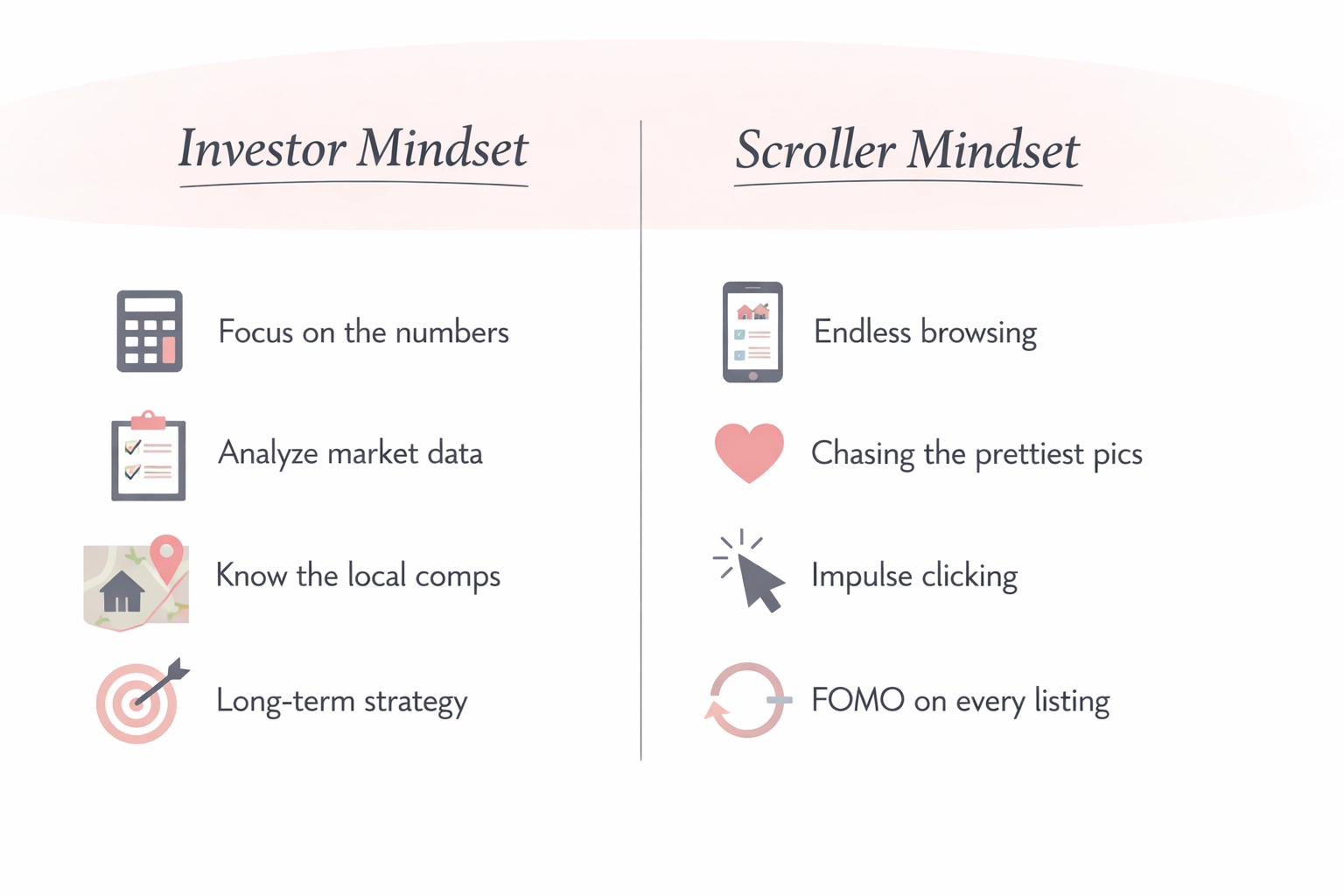
    We’ve all been there, the late-night Zillow spiral. You see a fixer-upper with a cute porch and suddenly you’re picking out backsplash tile and imagining the "For Sale" sign in the yard. This is Homeowner Energy—and it’s not a character flaw. It’s just what happens when you look at a house emotionally, not analytically.

    But Investor Authority is the moment you can appreciate the porch… and still say, “Yeah, no.”

    An investor doesn’t see a "cute porch." An investor sees a specific asset class, in a specific zip code, with a realistic renovation scope—and a margin that can survive the dust, the delays, and the random stuff that always pops up behind the walls.

    Investor Mindset vs. Reactive Buyer Mindset diagram

    "Beginners chase deals. Investors disqualify them."

    When you have a defined Buy Box, you stop being a "searcher" and start being an "analyzer." You aren't looking for a reason to buy; you are looking for a reason to say no. That shift is a Profit Protector move—because it keeps your capital out of emotional decisions and inside disciplined ones.

    Chapter 3: The Reality of Today’s Market

    Let’s get real about the market we’re standing in right now. This isn't 2021. You’re dealing with higher borrowing costs than we’ve seen in years. Insurance premiums are skyrocketing in many regions, and property taxes are adjusting upward.

    In many zip codes, homes aren't flying off the shelf in 48 hours anymore. They are sitting for 30, 45, or even 60 days. This means your margin for error has shrunk. A deal that "kind of works" actually doesn't work at all. To achieve Market Immunity, you need to understand that your profit isn't just "sale price minus purchase price." It’s the battle against holding costs and market fatigue.

    Woman holding a floor plan in a bright renovation context, clean and modern

    Chapter 4: The "Mythical Profit" Breakdown

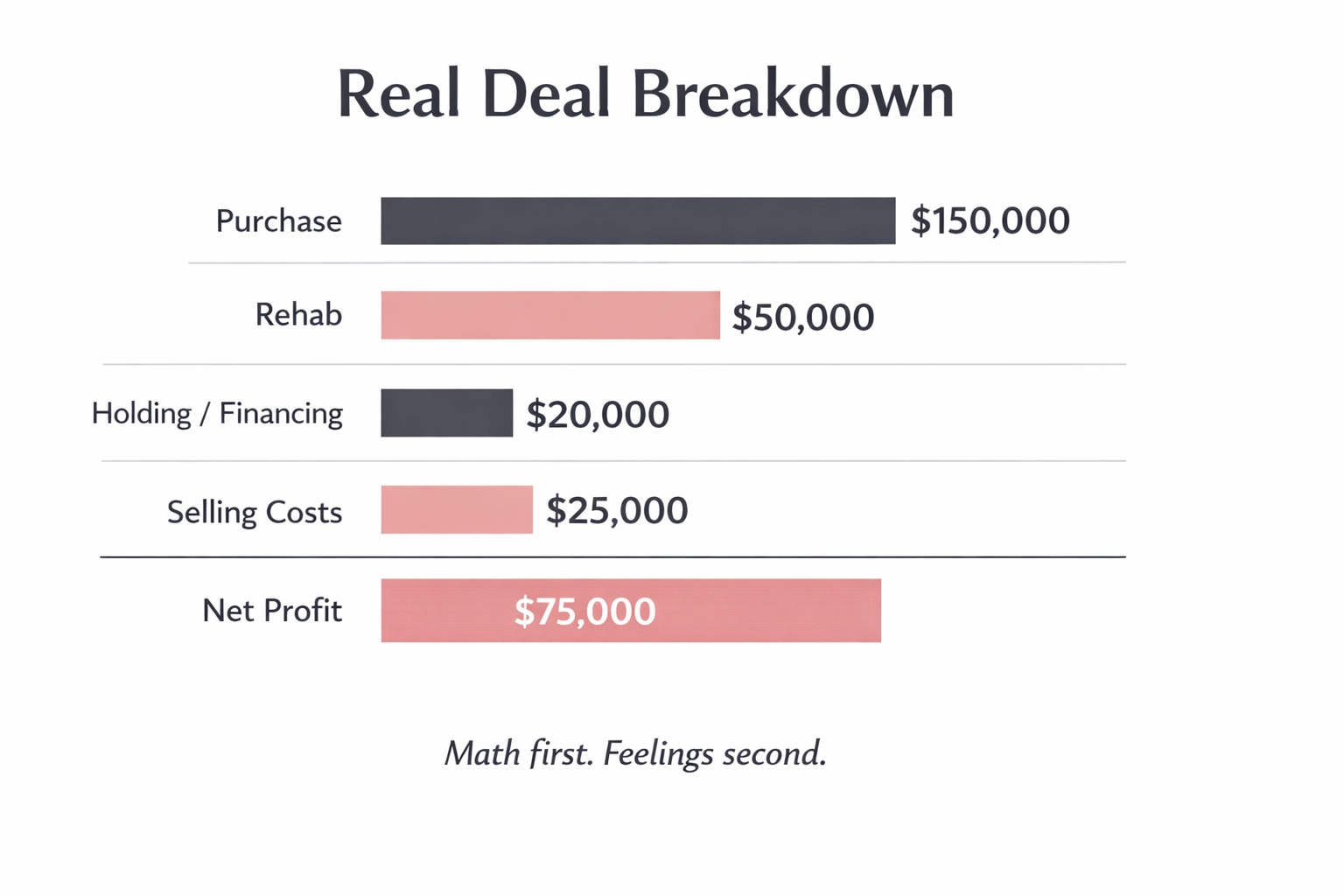
    I recently had a student send me a deal she was excited about. On the surface, it looked like a winner:

    • Purchase Price: $200,000
    • Estimated Rehab: $40,000
    • Expected Resale: $300,000

    She saw a $60,000 profit and started mentally spending that check. (We’ve all done it. That’s human.) But Investor Authority is the discipline to pause long enough to respect what the deal is really asking from you.

    Here’s what I want you to understand at a high level: those “extra” costs aren’t punishment—they’re the real-world price of running a project.

    • Financing costs exist because money has a cost. Even when you’re using a lender to move faster, that speed comes with a monthly clock attached.
    • Holding costs exist because the property is alive while you own it—utilities, insurance, taxes, lawn, trash, security. The house doesn’t care that your contractor is behind.
    • Transaction costs exist because buying and selling real estate has toll booths—agents, title, escrow, recording, fees. That’s part of the business.
    • Comps matter because the market is the final judge. Your after-photos might be gorgeous, but your buyer pool and neighborhood ceiling decide what you can actually get paid.

    So instead of getting stuck in “how do I calculate every line item,” think like a Profit Protector: How protected is my margin against time, surprises, and market mood?

    Here’s the clean way to see the logic of a protected margin—without turning this into a math lesson:

    Real Deal Breakdown chart showing purchase, rehab, holding/financing, selling costs, and net profit

    That’s why “mythical profit” is such a trap. A deal can look fine at a glance, but once real-life costs step on the stage, the margin tells the truth. And when the margin is thin, every delay turns into stress, and every surprise turns into a financial decision you didn’t plan for.

    Takeaway: The goal isn’t to become a spreadsheet wizard overnight. The goal is to understand why margins collapse—so you stop buying deals that only work in perfect conditions.

    Chapter 5: The Core Principle

    If you take nothing else from this, remember this phrase: You don’t lose money when you sell; you lose it when you buy wrong.

    By the time you put a "For Sale" sign in the yard, your fate is already sealed. The profit was either baked into the deal on day one, or it wasn't. Having a Buy Box helps ensure you only say "yes" to deals where the profit is protected from the start.

    Takeaway: The buy is where you win (or lose). Profit Protector thinking starts at the offer—because that’s where your margin gets decided.

    Chapter 6: What a Buy Box Actually Is

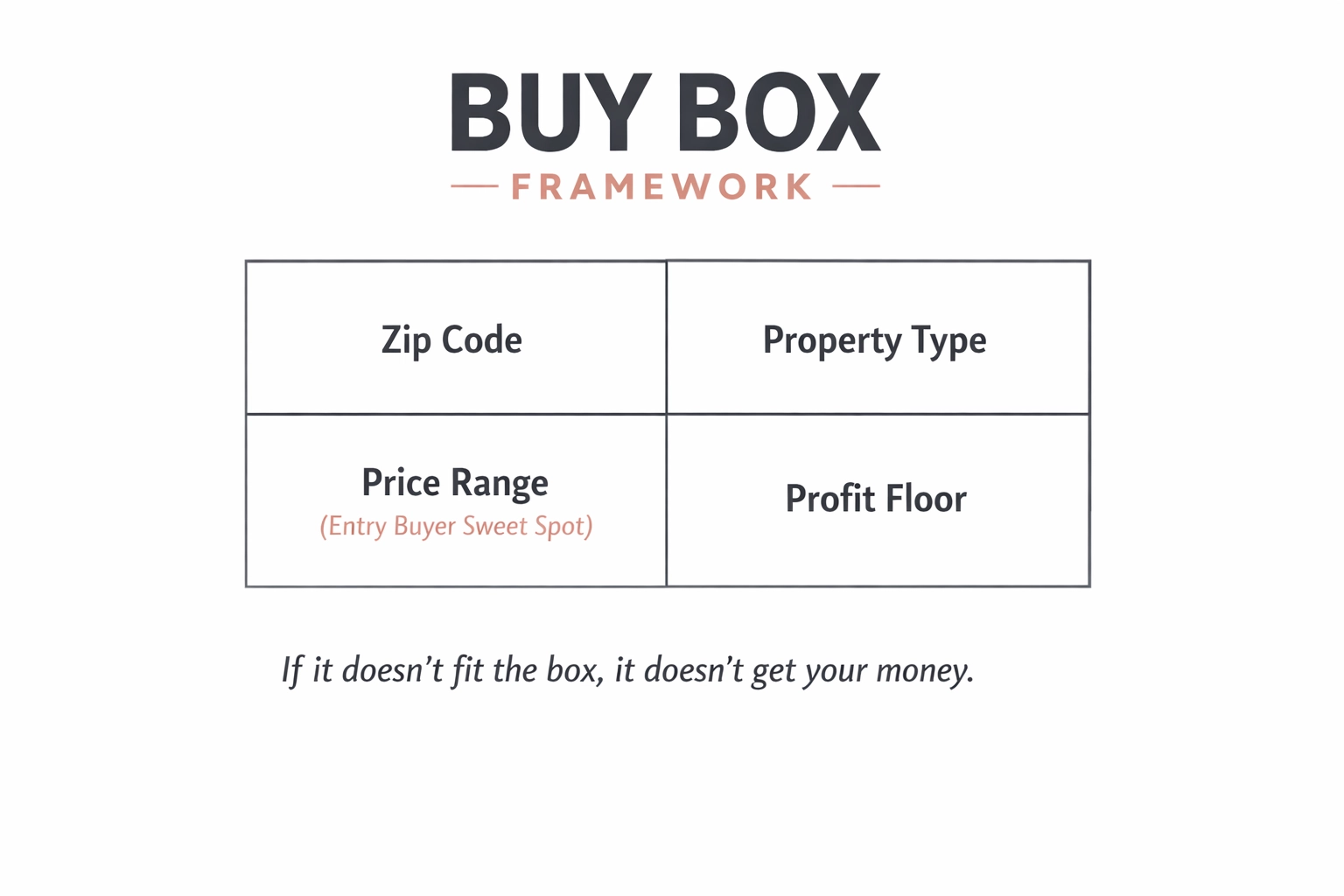
    Your Buy Box is your filter. It’s the “this is what we buy” definition you decide before the adrenaline hits. And it’s the fastest way I know to build Market Immunity—because you’re not getting yanked around by every new listing.

    Here’s the polished-but-real version of what you’re defining:

    Buy Box Framework visual with Zip Code, Property Type, Price Range, and Profit Floor

    Buy Box Checklist

    If you can’t answer these quickly, you’re not ready to buy yet—and that’s not shade, that’s protection.

    • Zip Code(s): Where you’re willing to compete and manage a project
    • Property Type: The kind of house you can confidently renovate and resell
    • Price Range: The “entry buyer” sweet spot your market actually supports
    • Profit Floor: The minimum that makes the risk, time, and stress worth it

    This is how you stop being “available for any deal” and start operating with Investor Authority—because now the deal has to impress you.

    Chapter 7: Why Markets Behave Differently

    Real estate is hyper-local. I’ve seen properties three minutes apart with the exact same layout and renovation level, where one sells in ten days and the other sits for two months. Why? Because one was on the "right" side of a major road or within a specific school district boundary.

    Without a Buy Box, you’re just guessing based on proximity. With one, you develop the local knowledge that allows you to spot a trap before you step in it.

    Side-by-side comparison of renovated houses demonstrating local market knowledge and a defined buy box. A side-by-side comparison of two seemingly identical houses with different market outcomes

    Chapter 8: The Architecture of a Professional Buy Box

    Let’s keep this out of “homework mode” and put it where it belongs: in Investor Authority.

    A Buy Box isn’t a cute checklist. It’s the architecture that holds up your decision-making when the market gets loud. This is the framework professional investors use to qualify opportunities—so they can move decisively on the right deals and ignore the rest without second-guessing.

    Here’s what a real Buy Box is designed to do:

    • Create Clarity: It reduces decision fatigue. You’re not evaluating every house—you’re qualifying the few that fit your business model.
    • Create Consistency: Repetition builds skill. When you stay in a defined lane (certain zip codes, certain property types), your pricing instincts sharpen and your project expectations get more realistic.
    • Create Risk Boundaries: A disciplined investor isn’t trying to “prove they can do anything.” She’s trying to protect profit and avoid projects that quietly drain time, cash, and confidence.
    • Create a Clean Exit: Investors with Market Immunity think about the end-buyer and neighborhood ceiling before they fall in love with finishes. A Buy Box keeps the exit strategy in the driver’s seat.

    In other words, your Buy Box is not a limitation—it’s a professional standard. It’s you choosing to operate like a Profit Protector, even when the market tries to tempt you into “just this once.”

    Takeaway: A strong Buy Box is a system for saying “yes” with confidence—and “no” without regret.

    Chapter 9: Common Mistakes to Avoid

    Most beginners don’t lose because they’re lazy. They lose because they’re unprotected—moving without a system, without a filter, and without experienced eyes on the deal.

    These are the traps I see most often, and more importantly, what they cost:

    • Copying Others: You inherit someone else’s risk tolerance, funding situation, and exit strategy—and then act shocked when the deal fits their business, not yours.
    • Emotional Buying (Homeowner Energy): You buy “potential,” then pay for it in change orders, timeline creep, and decisions made under stress.
    • The "One-Off" Trap: You buy the nicest house on the wrong block (or the weirdest house in a stable neighborhood). Then the market punishes you by limiting your buyer pool.
    • Entering Without Structure: You make decisions one property at a time, with no consistent standard. That’s how small mistakes stack into big losses—quietly, then all at once.

    This is why professional guidance matters. It’s not about hype—it’s about having a Profit Protector lens, a disciplined Buy Box, and the confidence to walk away before you get attached.

    Takeaway: The most expensive mistakes don’t look dramatic at first. They look like “it’ll probably be fine.” A system—and coaching—keeps “probably” out of your business.

    Conclusion: Final Thoughts + Next Steps

    The difference between a successful real estate entrepreneur and someone who loses their shirt is discipline. It’s the discipline to wait for the right opportunity—and the authority to say "no" to the wrong one without negotiating with your emotions.

    Stop reacting. Start deciding. Build your Buy Box, protect your margin, and operate with the authority you deserve.

    If you want to see this framework applied to live deals—how we evaluate risk, protect the profit, and avoid the “looks good on paper” traps—join us for the free live training this Saturday at 11:00 AM ET.

    Takeaway: Market Immunity isn’t luck. It’s structure—plus the confidence to stick to it when the market tries to rush you.

    Join the Free Webinar: This Saturday at 11:00 AM ET
    Register here: https://feminineflip.net/webinar


    Author Profile

    Meet Catricia

    Catricia Roberson
    Catricia Roberson is the Founder and Executive Director of The Feminine Flip. With years of experience in the trenches of real estate investing, she is dedicated to helping women transition from "scrolling" to "scaling" through structured education and high-level mentorship. Her mission is to empower women to build wealth with confidence, discipline, and authority.

    Connect with Catricia
    🔵 Facebook | 📸 Instagram | 💼 LinkedIn | ▶️ YouTube


    Legal Disclaimer
    The information provided in this blog post is for educational and informational purposes only and does not constitute financial, investment, or legal advice. Real estate investing involves significant risk, and past performance is not indicative of future results. Always consult with a licensed professional (such as an attorney, accountant, or financial advisor) before making any investment decisions. The Feminine Flip and its affiliates are not responsible for any financial losses incurred as a result of using the information provided.

    Ready to take the next step?
    Join us for the Free Webinar this Saturday at 11:00 AM ET: https://feminineflip.net/webinar

  • Mindset: Homeowner Energy vs. Investor Authority

    Mindset: Homeowner Energy vs. Investor Authority

    Intro Mindset Post — The Feminine Flip Formula


    Disclaimer: For educational purposes only. Real estate investing involves risk. No results are guaranteed. Consult with a professional before making investment decisions.


    You can learn the numbers. You can hire the contractor. You can even find the deal.

    But if you bring Homeowner Energy into an investor decision, you’ll still leak profit—quietly, consistently, and with a very reasonable-sounding explanation.

    Homeowner Energy isn’t “bad.” It’s protective. It wants certainty. It wants to be liked. It wants the house (or the deal) to work out because you’ve already emotionally moved in.

    Investor Authority is different. It’s leadership. It makes decisions that protect the margin before the market, the contractor, or the timeline gets a vote.

    This post is the mindset reset: Homeowner Energy vs. Investor Authority—and why that shift is often the difference between a flip that funds your life and a flip that quietly becomes a second job.

    The Problem: Homeowner Energy Pays for Certainty (and Investors Pay for Margin)

    Most first-time (and even seasoned) investors don’t lose money because they “can’t do real estate.”

    They lose money because they make business decisions like a buyer who’s trying to feel safe.

    Homeowner Energy shows up as:

    • “If I just get this one deal, I’ll figure it out as I go.”
    • “I don’t want to offend the seller, so I’ll come up a little.”
    • “The contractor seems nice… I don’t want to push too hard.”
    • “It’s fine—this upgrade will make it sell faster.”
    • “I can’t walk away now. I’ve already spent money on inspections.”

    None of those thoughts sound reckless. They sound responsible.

    But they create a pattern: you start buying certainty with your profit.

    And the market will happily accept that payment.

    Here’s what that looks like in real life:

    • Price creep: you “win” the deal, but you do it by shrinking your margin.
    • Scope creep: you start upgrading for emotion (“buyers will love it”) instead of strategy.
    • Timeline creep: you tolerate delays because confrontation feels uncomfortable.
    • Decision fatigue: you keep hoping the deal improves instead of making a clean call.

    A Profit Protector understands something simple: profit is not the reward for effort. Profit is the reward for leadership—and leadership starts with mindset.

    The Insight: Investor Authority Is a Boundary, Not a Personality

    A lot of women hear “be confident” and assume it means you need to become someone louder, sharper, or more aggressive.

    No.

    Investor Authority is not a personality upgrade. It’s a boundary upgrade.

    It’s the internal decision that:

    • your margin matters,
    • your standards are real,
    • and your money does not exist to rescue a deal that doesn’t deserve you.

    Investor Authority asks different questions:

    • “What does this deal need to be true for it to be worth my time?”
    • “What’s my Plan A—and what’s my Plan B if the market shifts?”
    • “Where does profit usually leak on deals like this?”
    • “What am I willing to say no to—even if everyone around me wants a yes?”

    This is where Market Immunity begins.

    Market Immunity isn’t pretending the market won’t change. It’s building your decisions so your deal isn’t fragile when it does.

    And that’s why mindset protects profit: because profit leaks are rarely one big mistake. They’re usually a series of small “reasonable” yeses.

    Professional woman investor reviewing renovation decisions on a tablet in a bright modern office with architectural plans and a calm, focused expression (AI-generated)

    Confidence: How to Spot Homeowner Energy Before It Costs You

    You don’t need more motivation. You need a quicker internal alarm system.

    Here are a few tells that Homeowner Energy is driving:

    • You’re negotiating against yourself before anyone else has spoken.
    • You feel relief when someone says yes—even if the terms are mediocre.
    • You’re avoiding a hard conversation and calling it “being flexible.”
    • You’re adding upgrades to reduce your anxiety, not increase your return.
    • You’re staying in a deal because leaving would feel embarrassing.

    Investor Authority sounds calmer:

    • “If the numbers don’t hold, we don’t proceed.”
    • “I’m willing to lose the deal to protect the margin.”
    • “I can be kind and still be clear.”
    • “I don’t need this deal. I need a deal that meets the standard.”

    That’s not toughness. That’s professionalism.

    And it’s how a Profit Protector runs projects without letting fear, urgency, or people-pleasing write checks from her budget.

    If you want to see how we teach women to build Investor Authority across the entire flipping process—without needing perfect credit, a big budget, or construction experience—I break it down in our free training at 11:00 AM ET: https://feminineflip.net/webinar

    The Bottom Line: The Deal Doesn’t Need Your Hope—It Needs Your Standards

    If you remember one thing, make it this:

    Homeowner Energy needs the deal to work. Investor Authority needs the deal to make sense.

    When you lead with Investor Authority, you protect profit in the places most investors don’t notice until it’s too late:

    • the “small” concession that becomes a big one,
    • the upgrade that makes you feel better but pays you back poorly,
    • the contractor delay you tolerated because you didn’t want to be “difficult,”
    • the offer you stretched because you were afraid the pipeline was empty.

    Profit Protectors don’t win by being perfect.

    They win by being consistent—because their mindset keeps their standards intact, even when emotions run high and timelines get tight.

    Ready to build Investor Authority and learn the Feminine Flip Formula—so you can flip with clarity, protect your profit, and create Market Immunity? Save your seat for the free webinar (11:00 AM ET).

    SAVE YOUR SPOT AT THE WEBINAR (11:00 AM ET)

    Key Teaching Points (for Sonny / Social Repurposing)

    • Homeowner Energy isn’t “wrong”—but it buys certainty with profit through small, reasonable-sounding concessions.
    • Investor Authority is a boundary, not a personality; it protects margin through standards you can consistently hold.
    • Profit Protectors don’t rely on perfect outcomes—they rely on clear decisions that prevent scope, price, and timeline creep.
    • Market Immunity starts at the mindset level: build decisions that aren’t fragile when the market shifts.
    • Confidence in real estate often looks calm: clear terms, clean boundaries, and a willingness to walk away.

    Meet Catricia

    Catricia Roberson, Founder & Executive Director of The Feminine Flip

    Catricia Roberson is the Founder and Executive Director of The Feminine Flip. With an MBA and years of high-level real estate experience, she has dedicated her career to helping women navigate the complexities of the real estate market. Her mission is to provide women with the education, systems, and confidence they need to build wealth through strategic property flipping and investment. Catricia believes that when women have the right tools and a CEO mindset, they are unstoppable in the world of business.

    Connect with Catricia:
    🔵 Facebook | 📸 Instagram | 💼 LinkedIn | ▶️ YouTube


    Disclaimer: For educational purposes only. Real estate investing involves risk. No results are guaranteed. Consult with a professional before making investment decisions.

    Ready to build Investor Authority and learn the Feminine Flip Formula—so you can flip with clarity, protect your profit, and create Market Immunity? Save your seat for the free webinar (11:00 AM ET).

    SAVE YOUR SPOT AT THE WEBINAR (11:00 AM ET)

  • Steps 4 & 5: The Profit Protector’s Guide: Why Your Contractor Isn’t the Boss of Your Budget

    Steps 4 & 5: The Profit Protector’s Guide: Why Your Contractor Isn’t the Boss of Your Budget


    Disclaimer: For educational purposes only. Real estate investing involves risk. No results are guaranteed. Consult with a professional before making investment decisions.


    Most flips don’t go sideways because the paint color was wrong.

    They go sideways because the investor quietly hands over the steering wheel the minute the contractor shows up.

    If you’ve ever caught yourself thinking:

    • “They’re the expert… so I’ll just let them run it.”
    • “I don’t want to be that client.”
    • “If I push back, they’ll walk.”

    …that’s Homeowner Energy dressed up as “being easy to work with.”

    But a Profit Protector knows the truth: when you abdicate leadership, your budget becomes a suggestion, your timeline becomes a vibe, and your scope becomes a moving target.

    That’s why Steps 4 & 5 in the Feminine Flip Formula—mapped into this 5-post series—are the renovation-phase leadership steps that keep you in Investor Authority:

    • Step 4: Contractor Leadership (you lead the people)
    • Step 5: Scope Control (you lead the plan)

    And yes: this is exactly why your contractor is not the boss of your budget.

    The Real Problem: “My Contractor Said We Had To” (The Most Expensive Sentence in a Flip)

    There are two types of contractor conversations that drain profits fast:

    1. The “upgrade” conversation
      “It’ll be better if we just…”
      Translation: your rehab just got bigger without your exit getting better.

    2. The “surprise” conversation
      “We opened the wall and found…”
      Translation: your risk plan is about to get tested—hard.

    New investors tend to respond with either panic or people-pleasing:

    • Panic spends money to make anxiety go away quickly.
    • People-pleasing spends money to keep the relationship comfortable.

    Both are costly.

    Investor Authority sounds different. It’s calm. It’s specific. It doesn’t confuse contractor confidence with investor alignment.

    A Profit Protector doesn’t need to know how to swing a hammer. She needs to know how to protect the margin.

    The Insight (Step 4): Contractor Leadership Is Not Micromanaging—It’s Management

    Contractor Leadership isn’t about hovering. It’s about setting the tone early so the project doesn’t turn into a daily negotiation.

    When you lead well, three things happen:

    • Expectations become explicit (so “I thought you meant…” disappears)
    • Communication becomes structured (so emergencies don’t get invented)
    • Accountability becomes normal (so your contractor doesn’t manage you)

    Here’s the mindset shift:

    Homeowner Energy hires a contractor hoping to be taken care of.
    Investor Authority hires a contractor expecting to run a business relationship.

    A Profit Protector creates clarity around:

    • who approves changes,
    • how decisions get documented,
    • when updates happen,
    • what “done” means before a check gets written.

    That isn’t being difficult. That’s being bankable.

    Because partners and lenders don’t fund “good vibes.” They fund leaders.

    A quick reality check: Contractors respect clarity more than friendliness

    Being kind is great. Being vague is expensive.

    You can be warm and firm. You can be collaborative and decisive. The renovation doesn’t need more emotion—it needs more leadership.

    A professional woman investor leading a renovation site walk-through with a clipboard, confidently speaking with a contractor (contractor not dominating the frame), unfinished kitchen in the background—Investor Authority, leadership, and calm control.

    The Insight (Step 5): Scope Control Is How You Build Market Immunity During the Rehab

    If Step 4 leads the people, Step 5 protects the plan.

    Scope creep is the quiet killer of flips. It rarely arrives as one giant bad decision. It arrives as ten “small” ones:

    • “Let’s upgrade to that nicer tile.”
    • “We might as well move that wall while we’re here.”
    • “Quartz is what buyers want, right?”
    • “We should add recessed lighting everywhere.”

    And sometimes those upgrades are worth it—but only if they serve your exit strategy and your neighborhood standards.

    Scope Control is the discipline of asking one question before any change gets approved:

    Does this increase the odds of a profitable exit—or just increase the invoice?

    This is where Market Immunity shows up inside the renovation. Market Immunity isn’t “doing the nicest reno.” It’s doing the right reno for the buyer and the price point—so your deal stays resilient even if:

    • the timeline stretches,
    • the market softens,
    • or the buyer pool gets pickier.

    A Profit Protector doesn’t renovate for ego. She renovates for outcome.

    The Confidence Shift: You Can Lead Contractors Without Construction Experience

    A lot of women hesitate here because they think:

    “If I don’t know construction, I can’t challenge the contractor.”

    That’s a myth.

    You don’t need to be a contractor to lead a contractor. You need to be the person who controls:

    • the objective (your exit),
    • the constraints (your budget + timeline),
    • and the decisions (your approvals).

    Construction expertise helps, but leadership is what protects profit.

    Investor Authority sounds like:

    • “What problem are we solving with this change?”
    • “Show me the options and the cost difference.”
    • “How does this affect the timeline?”
    • “Is this required for code/safety, or is it preference?”
    • “What’s the ROI rationale at this price point?”

    Those questions aren’t technical—they’re executive.

    And the more consistently you ask them, the less often you’ll hear, “We had to.”

    A modern desk scene: a woman’s hands reviewing a simple renovation scope document with a pen, a phone showing a contractor text thread, and a tidy budget worksheet—calm structure, Profit Protector energy.

    What This Looks Like in Real Life (Without Giving Away the Whole Playbook)

    High-level, Profit Protectors keep scope control by operating with a few non-negotiables:

    • One “source of truth” for the scope so you’re not managing 14 versions of “the plan”
    • A clear change-approval standard (no verbal “sure, go ahead” decisions)
    • A finish-level ceiling tied to the neighborhood and exit—not Pinterest
    • A leadership rhythm so the contractor isn’t only communicating when something’s on fire

    This isn’t about being rigid. It’s about being intentional.

    Because the moment you treat “scope” like a suggestion, your profit becomes optional.

    Mid-Article Soft Invite: Learn the Leadership Framework (Not Just the Renovation Tips)

    If you want to feel more confident leading contractors and controlling scope—without needing a construction background—the free training breaks down how we think about Investor Authority, Profit Protector decision-making, and Market Immunity from purchase through renovation. You can grab a seat for Saturday at 11:00 AM ET here: https://feminineflip.net/webinar

    Bring It Home: Your Contractor Has a Job. You Have a Business.

    Your contractor’s job is to complete work.

    Your job is to complete a profitable investment.

    That means you lead the renovation with:

    • Contractor Leadership (Step 4): clear expectations, structured communication, accountable execution
    • Scope Control (Step 5): a protected plan, disciplined upgrades, and Investor Authority approvals

    Homeowner Energy tries to keep everyone happy.

    Investor Authority protects the deal.

    And a Profit Protector doesn’t wait until the budget is blown to start acting like the boss—she decides that before the first demo day.

    Ready to learn how to lead your rehab like a CEO and protect your profit from scope creep?

    👉 REGISTER FOR THE FREE WEBINAR (SATURDAY 11:00 AM ET) 👈


    Meet Catricia

    Catricia Roberson, Founder & Executive Director of The Feminine Flip

    Catricia Roberson is the Founder and Executive Director of The Feminine Flip. With an MBA and years of high-level experience in real estate investing, she has dedicated her career to helping women navigate the complexities of property flipping. Catricia believes that with the right education and a supportive community, every woman can achieve financial independence through real estate. Her approach focuses on empowering women to step into leadership roles, master their budgets, and build lasting wealth.

    Connect with Catricia
    🔵 Facebook | 📸 Instagram | 💼 LinkedIn | ▶️ YouTube

    Are you ready to build your own legacy? Join our next free training and learn how to master the numbers and lead your projects with confidence.

    Disclaimer: For educational purposes only. Real estate investing involves risk. No results are guaranteed. Consult with a professional before making investment decisions.

  • Steps 6 & 7: The Exit Authority: Protecting Your Profit at the Finish Line

    Steps 6 & 7: The Exit Authority: Protecting Your Profit at the Finish Line


    Disclaimer: For educational purposes only. Real estate investing involves risk. No results are guaranteed. Consult with a professional before making investment decisions.


    Most flips don’t lose money at the purchase.

    They lose money at the finish line—when the rehab is “basically done,” the holding costs are stacking up, and Homeowner Energy starts narrating every end-of-project decision like it’s a referendum on your taste, your hustle, and your worth.

    This is where Investor Authority matters most.

    In the Feminine Flip Formula, the finish line is where Step 6: Profit Protection and Step 7: The Exit Authority lock arms. One protects your margin while the project is still moving. The other protects the outcome when the market starts pushing back.

    A Profit Protector doesn’t just create profit by buying well. She keeps profit by finishing well—staying calm, staying strategic, and building Market Immunity when timelines slip, buyers hesitate, or the comps don’t flatter your feelings.


    The Problem: The Finish Line Is Where Homeowner Energy Spends Your Margin

    If you’ve ever felt the urge to “just do a little more” right before listing, you already know the problem.

    The exit phase has a sneaky way of triggering Homeowner Energy—even in women who were disciplined the entire rehab—because suddenly:

    • You can see the result.
    • You’re tired.
    • You want to be done.
    • You want the market to “get it.”
    • You start craving a clean, validating win.

    That’s when margin gets spent in quiet, expensive ways:

    • Over-finishing: “It’s so close… let’s upgrade one more thing.”
    • Over-holding: “Let’s wait for the right buyer; I don’t want to lower the price.”
    • Over-conceding: “Fine, we’ll cover everything in credits just to close.”
    • Over-trusting a single outcome: “It’ll sell fast—no need for a backup plan.”

    Homeowner Energy treats the property like a personal masterpiece. It wants applause.

    Investor Authority treats the property like inventory with a timeline.

    And that distinction is the difference between hoping you profit and protecting profit.


    The Insight: Step 6 (Profit Protection) Is a Standard, Not a Single Decision

    Profit Protection isn’t one dramatic move—it’s the standard you maintain so you don’t bleed out slowly.

    At the end of a flip, profit loss is usually incremental:

    • an extra week here,
    • a handful of “small” upgrades there,
    • a pricing delay because you don’t want the market to vote “no,”
    • a negotiation where you give away leverage just to stop feeling anxious.

    Step 6 is about setting a business-level standard for decisions when emotions are loud. It’s how Profit Protectors build Market Immunity: they’re not dependent on perfect conditions to still finish profitably. They plan for friction.

    A few Profit Protection truths that keep Investor Authority online:

    • The market doesn’t reward effort. It rewards value as buyers define it.
    • Days on market is a cost. Financially, yes—but also mentally and operationally.
    • Beautiful isn’t the same as liquid. Liquidity is positioning + pricing + timing.
    • Control isn’t certainty. Control is having options—especially at the exit.

    Step 6 also means you stop asking, “What do I want?” (Homeowner Energy) and start asking, “What does the business need right now?” (Investor Authority).

    Close-up of a professional woman reviewing closing documents with a laptop on a modern desk


    The Confidence Shift: Step 7 (The Exit Authority) Is Investor Authority Under Pressure

    If Step 6 is the standard, Step 7 is the leadership.

    The Exit Authority is your ability to make clear, non-dramatic decisions at the exact moment most investors get reactive—when you’re tired, the money is tied up, and the market has opinions.

    It looks like this:

    You price with leadership, not ego

    Homeowner Energy hears “price reduction” and translates it into “I failed.”

    Investor Authority hears “feedback” and translates it into “data.”

    A Profit Protector understands that speed is not desperation—it’s strategy. You protect the win by protecting time, holding costs, and momentum.

    You negotiate like a business owner (not a people-pleaser)

    At the finish line, deals can get weird—inspection items, appraisal issues, buyer nerves, agent drama, and timelines that suddenly feel like a personal attack.

    Homeowner Energy says, “Just give them what they want so this doesn’t fall apart.”

    Investor Authority says, “What protects the deal and the margin?”

    Exit Authority doesn’t mean being rigid. It means being clear. You know what matters, what’s noise, and what costs too much—financially or strategically.

    You keep options alive—because Market Immunity is optionality

    Market Immunity is options.

    Exit Authority is not depending on one perfect outcome to feel successful. It’s maintaining leverage: the ability to pivot based on reality, not panic. (That might mean adjusting positioning, responding to buyer feedback without spiraling, or simply refusing to “chase” a number that the market isn’t paying.)

    If you want to see how we coach women to protect margin at the exit—without getting emotionally yanked around by the market—join our free Saturday webinar at 11:00 AM ET.


    A Quick Reality Check: A Great Flip Can Still Become a Bad Outcome Without Exit Leadership

    This is the part that stings (and saves you):

    You can buy well. You can rehab well. You can manage contractors well.

    And you can still give your profit away at the end if you let:

    • fatigue make you sloppy,
    • fear make you delay,
    • pride make you overprice,
    • “niceness” make you over-concede.

    Step 6 and Step 7 exist because the end of a flip is where your identity shows up. Not your Instagram vision board—your operating identity.

    A Profit Protector finishes like a CEO. She doesn’t confuse discomfort with danger. She doesn’t let Homeowner Energy negotiate on her behalf. And she doesn’t treat the exit like a popularity contest with the market.

    Because the market doesn’t care how hard the rehab was. It only cares what a qualified buyer will pay today—on a timeline that doesn’t let holding costs eat the win.


    Final Word: Steps 6 & 7 Are Where You Stop “Doing a Flip” and Start Running a Business

    Step 6: Profit Protection is the discipline to keep margin intact while the project is still in motion—especially when the temptation to “just spend a little more” shows up.

    Step 7: The Exit Authority is the leadership to close strong—pricing, positioning, and negotiating with Investor Authority instead of Homeowner Energy.

    That’s how Profit Protectors build Market Immunity: by making the final decisions with standards, not stress.

    If you’re ready to learn how we teach women to protect profit and exit with authority—without needing perfect credit, a massive budget, or construction experience—save your seat for the free Saturday training at 11:00 AM ET.

    👉 REGISTER FOR THE FREE WEBINAR (SATURDAY 11:00 AM ET)


    Key Teaching Points (for Sonny)

    • The finish line is where Homeowner Energy tries to spend your margin through over-finishing, over-holding, and over-conceding.
    • Step 6 (Profit Protection) is a standard you maintain, not a one-time decision; it prevents “incremental bleeding” in time, upgrades, and leverage.
    • Profit Protectors build Market Immunity by planning for friction and making decisions based on business needs—not emotional validation.
    • Step 7 (The Exit Authority) is Investor Authority under pressure: pricing from data, negotiating from clarity, and protecting leverage through options.
    • A great buy and rehab can still lose money without exit leadership; finishing like a CEO is what protects the win.

    Meet Catricia

    Catricia Roberson

    Catricia Roberson is the Founder and Executive Director of The Feminine Flip. With an MBA and years of high-level experience in real estate investing, Catricia has dedicated her career to helping women break into the world of house flipping with confidence, strategy, and style. Her mission is to move women from the "DIY Trap" into a position of Investor Leadership, ensuring they build wealth that lasts for generations.

    Connect with Catricia
    🔵 Facebook | 📸 Instagram | 💼 LinkedIn | ▶️ YouTube

    Disclaimer: For educational purposes only. Real estate investing involves risk. No results are guaranteed. Consult with a professional before making investment decisions.

  • Steps 2 & 3: Strategic ROI: How to Manufacture Equity without Picking Up a Hammer

    Steps 2 & 3: Strategic ROI: How to Manufacture Equity without Picking Up a Hammer


    Disclaimer: For educational purposes only. Real estate investing involves risk. No results are guaranteed. Consult with a professional before making investment decisions.


    Most new flippers assume the “real work” starts after closing—demo, design decisions, and contractor coordination.

    But your profit is usually decided before you ever own the house.

    The most expensive version of Homeowner Energy isn’t picking tile. It’s falling in love with a deal you haven’t earned on paper—and calling it “intuition.”

    In the Feminine Flip Formula series, this post covers Step 2: Analysis & Offer and Step 3: Deal Discipline (Market Immunity)—the part of the process where Investor Authority shows up early, so you don’t have to “make it up” later with stress, upgrades, and overtime.

    The Real Problem: Most Investors Don’t Lose Money in the Rehab—They Lose It in the Yes

    A flip can look “safe” because the house is cute, the neighborhood feels familiar, or the comps seem close enough.

    But a deal can still be wrong if:

    • you’re guessing on the rehab (or “rounding down” to feel better),
    • you’re using optimistic resale numbers,
    • you’re ignoring the time factor and carrying costs,
    • or you’re planning to negotiate later… after you’ve already overpaid.

    That’s not a character flaw. That’s a leadership gap.

    Investor Authority treats the offer like a business decision, not a hope-filled commitment.

    Step 2: Analysis & Offer — Strategic ROI Before You Ever Pick Up a Hammer

    Let’s define this the Feminine Flip way:

    Strategic ROI is the ability to manufacture equity with decision-making—not sweat equity.

    It’s how a Profit Protector thinks when she’s staring at a potential purchase and asking: “Where is the profit coming from—and how do I protect it?”

    Analysis isn’t about being “good at math.” It’s about being honest.

    The goal of analysis is not to prove a deal works.

    The goal is to stress-test the deal so you can see reality clearly—even when your emotions want to edit it.

    Homeowner Energy analysis sounds like:

    • “The ARV should be around this…”
    • “Rehab won’t be that bad…”
    • “Worst case, we’ll just add a little more money…”

    Investor Authority analysis sounds like:

    • “If my rehab is higher than expected, do I still have a deal?”
    • “If I’m on market longer than expected, do I still have a deal?”
    • “If my contractor timeline slips, do I still have a deal?”

    That’s Strategic ROI. Not perfection—protection.

    Your offer is where discipline becomes visible

    A lot of women struggle here because making an offer feels confrontational.

    So Homeowner Energy tries to “be reasonable” and ends up being expensive.

    But Deal Discipline isn’t being harsh. It’s being clear.

    The offer is simply your business stance: “This is what the deal is worth based on risk and numbers.” If the deal can’t support that stance, it’s not a deal—it’s a liability with lipstick.

    Close-up of a stylish feminine hand reviewing a renovation budget and contract on a laptop

    Step 3: Deal Discipline = Market Immunity (So You Don’t Chase the Wrong Price)

    If Step 2 is about seeing the deal clearly, Step 3 is about staying steady when the market (and your feelings) get loud.

    Market Immunity is the ability to stay aligned with what the market will pay—not what you wish it would pay.

    It’s also how you avoid the classic trap: paying retail and calling it investing.

    The “manufactured equity” myth that hurts beginners

    Many first-time flippers hear “you make money when you buy” and assume that means:

    • find a house,
    • renovate it,
    • and the equity will magically appear.

    But equity doesn’t appear because you renovated. It appears because you bought correctly relative to risk, resale realities, and time.

    When you don’t buy correctly, you end up trying to “manufacture equity” the hard way—with upgrades, over-improvements, and constant change orders.

    That’s Homeowner Energy wearing a hard hat.

    Deal Discipline is the ability to walk away without spiraling

    This is where confidence gets built.

    Not when a deal goes perfectly—but when you can calmly say:

    • “I’m not competing at that price.”
    • “The numbers don’t support my offer.”
    • “I’d rather be patient than be pressured.”

    The strongest investors aren’t the ones who can force a deal to work.

    They’re the ones who can decline a deal that doesn’t fit the buy box and still feel like a powerful woman in real estate.

    Market Immunity protects your identity

    This is the subtle part: without Market Immunity, you start tying your self-worth to whether you “win” a deal.

    So you chase.

    You waive contingencies you shouldn’t.
    You stop asking hard questions.
    You accept vague contractor answers.
    You tell yourself you’ll “figure it out.”

    That’s not ambition. That’s anxiety dressed up as hustle.

    Investor Authority doesn’t need to win every deal. She needs to win the right deal.

    The Confidence Piece: You Can Be New and Still Be Disciplined

    You don’t need construction experience to lead Step 2 and Step 3 well.

    You need structure.

    Because Strategic ROI isn’t about knowing everything. It’s about having an executive filter that keeps Homeowner Energy from making million-dollar decisions on a feeling.

    A Profit Protector knows this:

    • You can’t control the market.
    • You can’t control every surprise.
    • But you can control the quality of your buy—and the discipline of your offer.

    If you want to see how we teach women to analyze deals with Investor Authority (without getting overwhelmed) and build Market Immunity so they stop chasing bad deals, join my free live webinar this Saturday at 11:00 AM ET.

    The Feminine Flip Takeaway

    If you want to manufacture equity without picking up a hammer, it starts here:

    • Step 2 (Analysis & Offer): Strategic ROI is profit protection before purchase—clear-eyed numbers and leadership decisions.
    • Step 3 (Deal Discipline / Market Immunity): Discipline keeps you from chasing the wrong price and trying to “fix” a thin deal later.

    The fastest way to grow confidence isn’t doing more deals.
    It’s doing fewer deals with stronger leadership.

    Ready to learn the Feminine Flip framework for analyzing deals, making confident offers, and protecting your profit from the very beginning?

    👉 REGISTER FOR THE FREE WEBINAR (SATURDAY 11:00 AM ET)


    Meet Catricia

    Catricia Roberson

    Catricia Roberson is the Founder and Executive Director of The Feminine Flip. With an MBA and a background in high-stakes project leadership, she transitioned from the corporate world to real estate to empower women to take control of their financial destinies. Catricia believes that real estate investing is the ultimate vehicle for female empowerment, and she is dedicated to teaching women how to build wealth through strategic, CEO-level decision-making.

    Connect with Catricia
    🔵 Facebook | 📸 Instagram | 💼 LinkedIn | ▶️ YouTube

    Ready to start your journey?
    Join our next Free Webinar and learn the framework for your first (or next) successful flip.

    Key Teaching Points (for social repurposing)

    • Most profit problems start before closing: “pretty deal” energy can hide thin numbers and real risk.
    • Step 2 (Analysis & Offer) is where Investor Authority shows up early: analysis stress-tests reality instead of trying to “prove” a deal works.
    • Strategic ROI is manufacturing equity with decision-making—not sweat equity—by protecting the deal from rehab, timeline, and resale surprises.
    • Step 3 (Deal Discipline) is Market Immunity: staying aligned with what the market will pay, not what you hope it will pay.
    • Deal Discipline builds confidence: walking away from the wrong price is a leadership move, not a failure.
    • Homeowner Energy chases and rationalizes; Investor Authority stays calm, clear, and consistent.

    Disclaimer: For educational purposes only. Real estate investing involves risk. No results are guaranteed. Consult with a professional before making investment decisions.

  • Step 1: The $10,000 Filter: The Buy Box Blueprint

    Step 1: The $10,000 Filter: The Buy Box Blueprint


    Disclaimer: For educational purposes only. Real estate investing involves risk. No results are guaranteed. Consult with a professional before making investment decisions.


    You can learn rehab budgets. You can learn contractor management. You can even learn how to negotiate.

    But if your Buy Box is fuzzy, none of that matters—because you’ll keep buying “almost-deals” that quietly erase your profit.

    This is why we teach Step 1 of The Feminine Flip Formula™ as the Buy Box Blueprint. Before you ever open a spreadsheet, tour a property, or let Homeowner Energy talk you into “potential,” you need one thing: a filter that protects your margin.

    I call it the $10,000 Filter, because a sloppy Buy Box rarely costs you a little. It usually costs you five figures—in holding costs, surprise rehab scope, price reductions, or the worst one: a deal that technically sells, but doesn’t actually pay you.

    The Problem: “It’s a Good Deal” Is Not a Strategy

    Most new flippers don’t have a buying problem. They have a decision problem.

    When you don’t define your Buy Box, every house becomes a maybe:

    • “It’s in an up-and-coming area.”
    • “It’s only 15 minutes farther than I wanted.”
    • “It’s a little bigger than my comfort zone, but we can figure it out.”
    • “The ARV seems strong… I think.”

    That’s Homeowner Energy doing what it does best: prioritizing excitement, possibility, and emotional momentum.

    But flips don’t get paid on possibility. They get paid on precision.

    A Profit Protector doesn’t buy “good deals.” She buys deals that match her Buy Box—because her Buy Box is designed to keep her in Investor Authority from the first offer to the final sale.

    The Insight: Your Buy Box Is a Profit Protection Tool

    A Buy Box isn’t just “the kind of house you like.” It’s the boundary that keeps you from walking into risk you can’t see yet.

    Here’s what Step 1 really does:

    • It reduces surprise by narrowing the neighborhoods, price points, and property types you’re willing to take on.
    • It improves speed and confidence because you can quickly rule deals in or out without overthinking.
    • It creates Market Immunity by making your deals less sensitive to chaos (extra days on market, minor rate shifts, small appraisal issues) because you aren’t buying on the edge.

    The Buy Box is what lets you say, calmly and clearly: “That house might be fine… but it’s not for my business.”

    That’s Investor Authority.

    What a “$10,000 Filter” Looks Like in Real Life

    The fastest way to lose $10,000 is to let your Buy Box be a vibe.

    A Buy Box is where you pre-decide your standards—so you don’t negotiate with yourself in the field.

    A few examples of what your Buy Box is protecting you from:

    • The “cute” house that’s functionally wrong for the neighborhood. Over-improving is real. And it’s expensive.
    • The tempting deal in an area you don’t understand yet. Unfamiliar streets create unfamiliar outcomes.
    • The property type that sounds fine until it isn’t. Layout quirks, additions, heavy foundation risk, or properties that attract a buyer pool you don’t know how to serve.
    • The deal that forces you into a rehab you can’t manage. Not because you aren’t smart—but because your timelines, cash flow, and contractor bench aren’t built for that level yet.

    A clean Buy Box keeps you from buying into complexity before you’ve built the structure to handle it.

    If you want the simplest version of the mindset: a Buy Box is the line between “I can handle this” and “this will handle me.”

    Investor Authority Starts Before the Offer

    People often think Investor Authority is how you talk to contractors or negotiate with sellers.

    It’s earlier than that.

    Investor Authority is being willing to walk away from a deal that doesn’t fit—even when it looks like “a steal,” even when your agent is excited, even when you’re tired of searching.

    Because tired buyers make expensive choices.

    A Profit Protector knows that discipline feels slow on the front end… and saves months (and money) on the back end.

    This is also where confidence gets built. Not from hype. From standards.

    When you know what you’re looking for, you stop feeling like every deal is a test you can fail. You start operating like a buyer with a plan.

    The Beginner Trap: Confusing Flexibility With Opportunity

    A common myth is: “I should keep my Buy Box wide so I don’t miss opportunities.”

    In practice, a wide Buy Box usually means you’re saying yes to:

    • more unknowns,
    • more contractor questions,
    • more budgeting pressure,
    • and more emotional decision-making.

    That’s how flips become exhausting.

    A tighter Buy Box is not limiting—it’s clarifying. It helps you spot the right deals faster, and it helps you make cleaner decisions when you’re under pressure.

    And pressure is guaranteed in this business.

    A Soft Invitation (Because Step 1 Is Where the Confusion Usually Starts)

    If you’ve ever thought, “I don’t know what I should be looking for,” you’re not behind—you’re just missing a filter.

    In our free training this Saturday at 11:00 AM ET, we break down how the Feminine Flip Formula™ helps you set your Buy Box with clarity—so you stop chasing deals that drain you and start evaluating opportunities from Investor Authority. You can save your seat here: https://feminineflip.net/webinar.

    Confidence: You Don’t Need More Deals—You Need Better “No’s”

    The Buy Box Blueprint isn’t about being picky. It’s about being protected.

    Because every “no” you make early:

    • protects your cash,
    • protects your timeline,
    • protects your focus,
    • and protects your confidence.

    You don’t build confidence by forcing yourself to do harder deals. You build confidence by doing aligned deals well—then expanding from a position of strength.

    That’s how Market Immunity is built: not by predicting the market perfectly, but by buying with enough margin, clarity, and structure that you’re not fragile.

    And that all starts with Step 1.

    Take the Next Step

    Ready to stop guessing and start filtering deals like a Profit Protector?

    Register for our upcoming Free Webinar: The Feminine Flip Formula™
    Date: This Saturday
    Time: 11:00 AM ET
    Link: https://feminineflip.net/webinar


    Meet Catricia

    Catricia Roberson
    Catricia Roberson is the Founder and Executive Director of The Feminine Flip. With an MBA and years of high-stakes real estate experience, she has dedicated her career to helping women transition from high-achieving professionals to empowered real estate investors. Her mission is to provide the leadership, structure, and strategic "Profit Protector" mindset necessary to build lasting wealth through real estate.

    Connect with Catricia
    🔵 Facebook | 📸 Instagram | 💼 LinkedIn | ▶️ YouTube

    Ready to transform your approach?
    Join our Free Webinar this Saturday at 11:00 AM ET!

    Disclaimer: For educational purposes only. Real estate investing involves risk. No results are guaranteed. Consult with a professional before making investment decisions.