Category: Blog

Your blog category

  • Mindset: Homeowner Energy vs. Investor Authority

    Mindset: Homeowner Energy vs. Investor Authority

    Intro Mindset Post — The Feminine Flip Formula


    Disclaimer: For educational purposes only. Real estate investing involves risk. No results are guaranteed. Consult with a professional before making investment decisions.


    You can learn the numbers. You can hire the contractor. You can even find the deal.

    But if you bring Homeowner Energy into an investor decision, you’ll still leak profit—quietly, consistently, and with a very reasonable-sounding explanation.

    Homeowner Energy isn’t “bad.” It’s protective. It wants certainty. It wants to be liked. It wants the house (or the deal) to work out because you’ve already emotionally moved in.

    Investor Authority is different. It’s leadership. It makes decisions that protect the margin before the market, the contractor, or the timeline gets a vote.

    This post is the mindset reset: Homeowner Energy vs. Investor Authority—and why that shift is often the difference between a flip that funds your life and a flip that quietly becomes a second job.

    The Problem: Homeowner Energy Pays for Certainty (and Investors Pay for Margin)

    Most first-time (and even seasoned) investors don’t lose money because they “can’t do real estate.”

    They lose money because they make business decisions like a buyer who’s trying to feel safe.

    Homeowner Energy shows up as:

    • “If I just get this one deal, I’ll figure it out as I go.”
    • “I don’t want to offend the seller, so I’ll come up a little.”
    • “The contractor seems nice… I don’t want to push too hard.”
    • “It’s fine—this upgrade will make it sell faster.”
    • “I can’t walk away now. I’ve already spent money on inspections.”

    None of those thoughts sound reckless. They sound responsible.

    But they create a pattern: you start buying certainty with your profit.

    And the market will happily accept that payment.

    Here’s what that looks like in real life:

    • Price creep: you “win” the deal, but you do it by shrinking your margin.
    • Scope creep: you start upgrading for emotion (“buyers will love it”) instead of strategy.
    • Timeline creep: you tolerate delays because confrontation feels uncomfortable.
    • Decision fatigue: you keep hoping the deal improves instead of making a clean call.

    A Profit Protector understands something simple: profit is not the reward for effort. Profit is the reward for leadership—and leadership starts with mindset.

    The Insight: Investor Authority Is a Boundary, Not a Personality

    A lot of women hear “be confident” and assume it means you need to become someone louder, sharper, or more aggressive.

    No.

    Investor Authority is not a personality upgrade. It’s a boundary upgrade.

    It’s the internal decision that:

    • your margin matters,
    • your standards are real,
    • and your money does not exist to rescue a deal that doesn’t deserve you.

    Investor Authority asks different questions:

    • “What does this deal need to be true for it to be worth my time?”
    • “What’s my Plan A—and what’s my Plan B if the market shifts?”
    • “Where does profit usually leak on deals like this?”
    • “What am I willing to say no to—even if everyone around me wants a yes?”

    This is where Market Immunity begins.

    Market Immunity isn’t pretending the market won’t change. It’s building your decisions so your deal isn’t fragile when it does.

    And that’s why mindset protects profit: because profit leaks are rarely one big mistake. They’re usually a series of small “reasonable” yeses.

    Professional woman investor reviewing renovation decisions on a tablet in a bright modern office with architectural plans and a calm, focused expression (AI-generated)

    Confidence: How to Spot Homeowner Energy Before It Costs You

    You don’t need more motivation. You need a quicker internal alarm system.

    Here are a few tells that Homeowner Energy is driving:

    • You’re negotiating against yourself before anyone else has spoken.
    • You feel relief when someone says yes—even if the terms are mediocre.
    • You’re avoiding a hard conversation and calling it “being flexible.”
    • You’re adding upgrades to reduce your anxiety, not increase your return.
    • You’re staying in a deal because leaving would feel embarrassing.

    Investor Authority sounds calmer:

    • “If the numbers don’t hold, we don’t proceed.”
    • “I’m willing to lose the deal to protect the margin.”
    • “I can be kind and still be clear.”
    • “I don’t need this deal. I need a deal that meets the standard.”

    That’s not toughness. That’s professionalism.

    And it’s how a Profit Protector runs projects without letting fear, urgency, or people-pleasing write checks from her budget.

    If you want to see how we teach women to build Investor Authority across the entire flipping process—without needing perfect credit, a big budget, or construction experience—I break it down in our free training at 11:00 AM ET: https://feminineflip.net/webinar

    The Bottom Line: The Deal Doesn’t Need Your Hope—It Needs Your Standards

    If you remember one thing, make it this:

    Homeowner Energy needs the deal to work. Investor Authority needs the deal to make sense.

    When you lead with Investor Authority, you protect profit in the places most investors don’t notice until it’s too late:

    • the “small” concession that becomes a big one,
    • the upgrade that makes you feel better but pays you back poorly,
    • the contractor delay you tolerated because you didn’t want to be “difficult,”
    • the offer you stretched because you were afraid the pipeline was empty.

    Profit Protectors don’t win by being perfect.

    They win by being consistent—because their mindset keeps their standards intact, even when emotions run high and timelines get tight.

    Ready to build Investor Authority and learn the Feminine Flip Formula—so you can flip with clarity, protect your profit, and create Market Immunity? Save your seat for the free webinar (11:00 AM ET).

    SAVE YOUR SPOT AT THE WEBINAR (11:00 AM ET)

    Key Teaching Points (for Sonny / Social Repurposing)

    • Homeowner Energy isn’t “wrong”—but it buys certainty with profit through small, reasonable-sounding concessions.
    • Investor Authority is a boundary, not a personality; it protects margin through standards you can consistently hold.
    • Profit Protectors don’t rely on perfect outcomes—they rely on clear decisions that prevent scope, price, and timeline creep.
    • Market Immunity starts at the mindset level: build decisions that aren’t fragile when the market shifts.
    • Confidence in real estate often looks calm: clear terms, clean boundaries, and a willingness to walk away.

    Meet Catricia

    Catricia Roberson, Founder & Executive Director of The Feminine Flip

    Catricia Roberson is the Founder and Executive Director of The Feminine Flip. With an MBA and years of high-level real estate experience, she has dedicated her career to helping women navigate the complexities of the real estate market. Her mission is to provide women with the education, systems, and confidence they need to build wealth through strategic property flipping and investment. Catricia believes that when women have the right tools and a CEO mindset, they are unstoppable in the world of business.

    Connect with Catricia:
    🔵 Facebook | 📸 Instagram | 💼 LinkedIn | ▶️ YouTube


    Disclaimer: For educational purposes only. Real estate investing involves risk. No results are guaranteed. Consult with a professional before making investment decisions.

    Ready to build Investor Authority and learn the Feminine Flip Formula—so you can flip with clarity, protect your profit, and create Market Immunity? Save your seat for the free webinar (11:00 AM ET).


    SAVE YOUR SPOT AT THE WEBINAR (11:00 AM ET)

  • Renovation & Contractor Authority

    Cover Image: professional woman investor holding a tablet inside a renovation project

    Editor’s Note

    In the world of real estate investing, there is a massive divide between women who renovate and women who run renovations. That divide is Investor Authority.

    Most investors enter rehab with Homeowner Energy. They focus on selections, finishes, and “making it cute,” while their margin gets quietly taxed by delays, vague expectations, and contractor-led decision-making. The Feminine Flip Formula was built to eliminate that drift.

    This volume is about Contractor Control—not through intensity, but through clarity. The renovation phase is where profits are either protected or surrendered. Your job is to operate as the Profit Protector from day one, so the deal maintains Market Immunity all the way to the exit.

    Table of Contents

    • Introduction: From Buying to Building
    • Chapter 1: The $10,000 View
    • Chapter 2: Contractor Control vs. Contractor Chaos
    • Chapter 3: The Reality of the Rehab
    • Chapter 4: The Scope-of-Work Standard
    • Chapter 5: Profit is Protected in the Process
    • Chapter 6: Hidden Costs & Decision Drift
    • Chapter 7: Communication as a Control System
    • Chapter 8: Project Discipline & Market Immunity
    • Chapter 9: Field Mistakes that Kill Margins
    • Conclusion: Final Thoughts & The Next Move

    Introduction: From Buying to Building

    The thrill of the close is over. You’ve secured the asset using your Buy Box, and now the real work begins. Many investors think the hard part is finding the deal. They are wrong. The hard part is keeping the profit you projected on paper.

    To move from an acquisition mindset to an execution mindset, you must shift from being liked to being respected. You are the CEO of the project. This is about driving your renovation to the finish line without losing your mind or your margin.

    Chapter 1: The $10,000 View

    Management is not doing the work; it is ensuring the work is done to your standard. To maintain Investor Authority, you must operate from the $10,000 view.

    When you get pulled into small decisions, you lose control of the big picture. Renovations don’t fail all at once—they fail through small gaps that go unchecked.

    If you cannot see the full project clearly, you cannot protect the full profit.

    Chapter 2: Contractor Control vs. Contractor Chaos

    Contractors perform best when they are led. Chaos shows up when expectations are unclear.

    Contractor Control is not about being difficult—it’s about being specific. Your contractor is running a trade. You are running an investment.

    Without clear standards, your project becomes contractor-led instead of investor-led. And that’s where profit starts to disappear.

    Chapter 3: The Reality of the Rehab

    Rehab is where Homeowner Energy gets exposed. It is messy, fast-moving, and expensive.

    Renovation in progress with clean but unfinished interior

    Every delay increases your costs and reduces your options. This is where Market Immunity is either protected or weakened.

    The longer a problem goes unchecked, the more expensive it becomes.

    Chapter 4: The Scope-of-Work Standard

    Your strongest protection is a clear scope of work.

    A vague scope creates confusion. Confusion creates change orders. Change orders reduce profit.

    Clarity is control.

    The Profit Protector doesn’t argue—they reference the agreement and keep the project aligned.

    Chapter 5: Profit is Protected in the Process

    Profit is not made at the sale—it is protected during execution.

    Modern finished kitchen with balanced upgrades

    Without a system, decisions become emotional. With structure, decisions stay aligned with the numbers.

    This is how you maintain control under pressure.

    Chapter 6: Hidden Costs & Decision Drift

    Small changes add up fast.

    Each adjustment affects:

    • timeline
    • budget
    • momentum

    If decisions are made casually, profit disappears quietly.

    The Profit Protector treats every change as a business decision—not a quick fix.

    Chapter 7: Communication as a Control System

    Communication is not about checking in—it’s about maintaining control.

    Without clear communication:

    • expectations shift
    • timelines stretch
    • accountability disappears

    Investor Authority communicates clearly, consistently, and without emotion.

    Chapter 8: Project Discipline & Market Immunity

    Discipline protects your margin.

    Investor reviewing renovation numbers and budget

    Overspending, over-upgrading, or reacting emotionally weakens your deal.

    Discipline keeps your project aligned with the outcome—not your feelings.

    Chapter 9: Field Mistakes that Kill Margins

    • Over-improving for the neighborhood
    • Letting contractors lead decisions
    • Paying before progress is verified
    • Poor documentation
    • Emotional decision-making under pressure

    Conclusion: Final Thoughts & The Next Move

    Renovation is where projected profit becomes real—or disappears.

    If you want consistent results, you need structure:

    • Investor Authority
    • Contractor Control
    • Profit Protector mindset
    • Market Immunity

    Author Profile

    Catricia Roberson

    Catricia Roberson is the Founder & Executive Director of The Feminine Flip. She helps women build Investor Authority so they can lead renovations, enforce Contractor Control, protect profit as the Profit Protector, and keep every deal positioned for Market Immunity—without guesswork.

    Connect with Catricia: 🔵 | 📸 | 💼 | ▶️

    Disclaimer

    LEGAL DISCLAIMER: For educational purposes only. Not financial/legal advice. Results vary. Full terms at feminineflip.net/terms

  • Investor Authority: How to Define Your Buy Box and Stop Making Expensive Real Estate Mistakes

    Investor Authority: How to Define Your Buy Box and Stop Making Expensive Real Estate Mistakes

    Cover Page

    Polished but real hero image: professional woman investor reviewing a floor plan in a modern renovation setting


    Editor’s Note: Welcome to the Guide

    This is a strategic Feminine Flip framework designed to help you master the investor mindset. It’s a deep-dive into the core strategy behind the Feminine Flip Formula—so you can think like a Profit Protector, operate with Investor Authority, and build Market Immunity before you ever put a deal under contract.


    Table of Contents


    Introduction: A Letter From the Author

    I can usually tell within about three minutes of a conversation who is about to move like a seasoned pro and who is about to learn a very expensive, very painful lesson.

    It usually starts when a beginner tells me, “I found this great house on Zillow. I think it could be a really good deal.” When I ask them what their Buy Box is, there’s a long, awkward pause.

    That pause is the sound of money leaking out of a future bank account.

    In real estate investing, "guessing" is just a fancy word for "gambling with your life savings." If you want to move from being a hobbyist to operating with true Investor Authority, you have to stop reacting to the market and start deciding what you want from it before you ever log onto an app.

    Takeaway: Investor Authority isn’t a vibe. It’s a decision you make in advance—so your money stops getting dragged around by your emotions.

    Chapter 1: The $10,000 View

    I call this the "$10,000 View." Before an experienced investor ever looks at a single property, they already know exactly what they are willing to buy. Their decision isn't based on what happens to show up in their inbox that morning; it’s based on what works for their business model.

    Most beginners do the exact opposite. They browse listings, see a house with "potential" (a dangerous word in this business), and then try to perform mental gymnastics to make the numbers fit. They are reacting. Real Investor Authority is about deciding in advance. It’s about having a filter so strong that 95% of the "deals" out there don't even make it past your first glance.

    Chapter 2: Beginner vs. Investor Mindset

    We’ve all been there, the late-night Zillow spiral. You see a fixer-upper with a cute porch and suddenly you’re picking out backsplash tile and imagining the "For Sale" sign in the yard. This is Homeowner Energy—and it’s not a character flaw. It’s just what happens when you look at a house emotionally, not analytically.

    But Investor Authority is the moment you can appreciate the porch… and still say, “Yeah, no.”

    An investor doesn’t see a "cute porch." An investor sees a specific asset class, in a specific zip code, with a realistic renovation scope—and a margin that can survive the dust, the delays, and the random stuff that always pops up behind the walls.

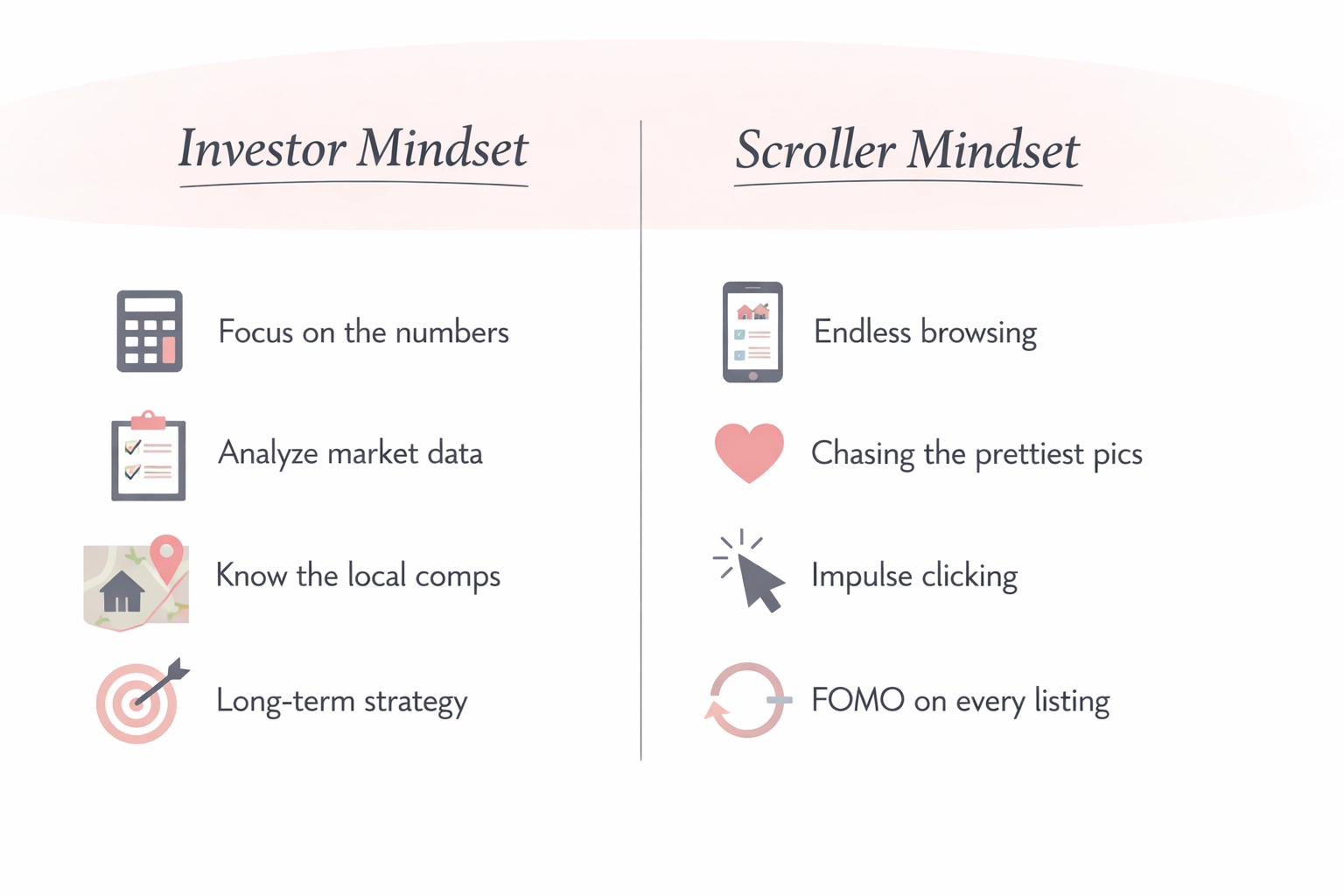
    Investor Mindset vs. Reactive Buyer Mindset diagram

    "Beginners chase deals. Investors disqualify them."

    When you have a defined Buy Box, you stop being a "searcher" and start being an "analyzer." You aren't looking for a reason to buy; you are looking for a reason to say no. That shift is a Profit Protector move—because it keeps your capital out of emotional decisions and inside disciplined ones.

    Chapter 3: The Reality of Today’s Market

    Let’s get real about the market we’re standing in right now. This isn't 2021. You’re dealing with higher borrowing costs than we’ve seen in years. Insurance premiums are skyrocketing in many regions, and property taxes are adjusting upward.

    In many zip codes, homes aren't flying off the shelf in 48 hours anymore. They are sitting for 30, 45, or even 60 days. This means your margin for error has shrunk. A deal that "kind of works" actually doesn't work at all. To achieve Market Immunity, you need to understand that your profit isn't just "sale price minus purchase price." It’s the battle against holding costs and market fatigue.

    Woman holding a floor plan in a bright renovation context, clean and modern

    Chapter 4: The "Mythical Profit" Breakdown

    I recently had a student send me a deal she was excited about. On the surface, it looked like a winner:

    • Purchase Price: $200,000
    • Estimated Rehab: $40,000
    • Expected Resale: $300,000

    She saw a $60,000 profit and started mentally spending that check. (We’ve all done it. That’s human.) But Investor Authority is the discipline to pause long enough to respect what the deal is really asking from you.

    Here’s what I want you to understand at a high level: those “extra” costs aren’t punishment—they’re the real-world price of running a project.

    • Financing costs exist because money has a cost. Even when you’re using a lender to move faster, that speed comes with a monthly clock attached.
    • Holding costs exist because the property is alive while you own it—utilities, insurance, taxes, lawn, trash, security. The house doesn’t care that your contractor is behind.
    • Transaction costs exist because buying and selling real estate has toll booths—agents, title, escrow, recording, fees. That’s part of the business.
    • Comps matter because the market is the final judge. Your after-photos might be gorgeous, but your buyer pool and neighborhood ceiling decide what you can actually get paid.

    So instead of getting stuck in “how do I calculate every line item,” think like a Profit Protector: How protected is my margin against time, surprises, and market mood?

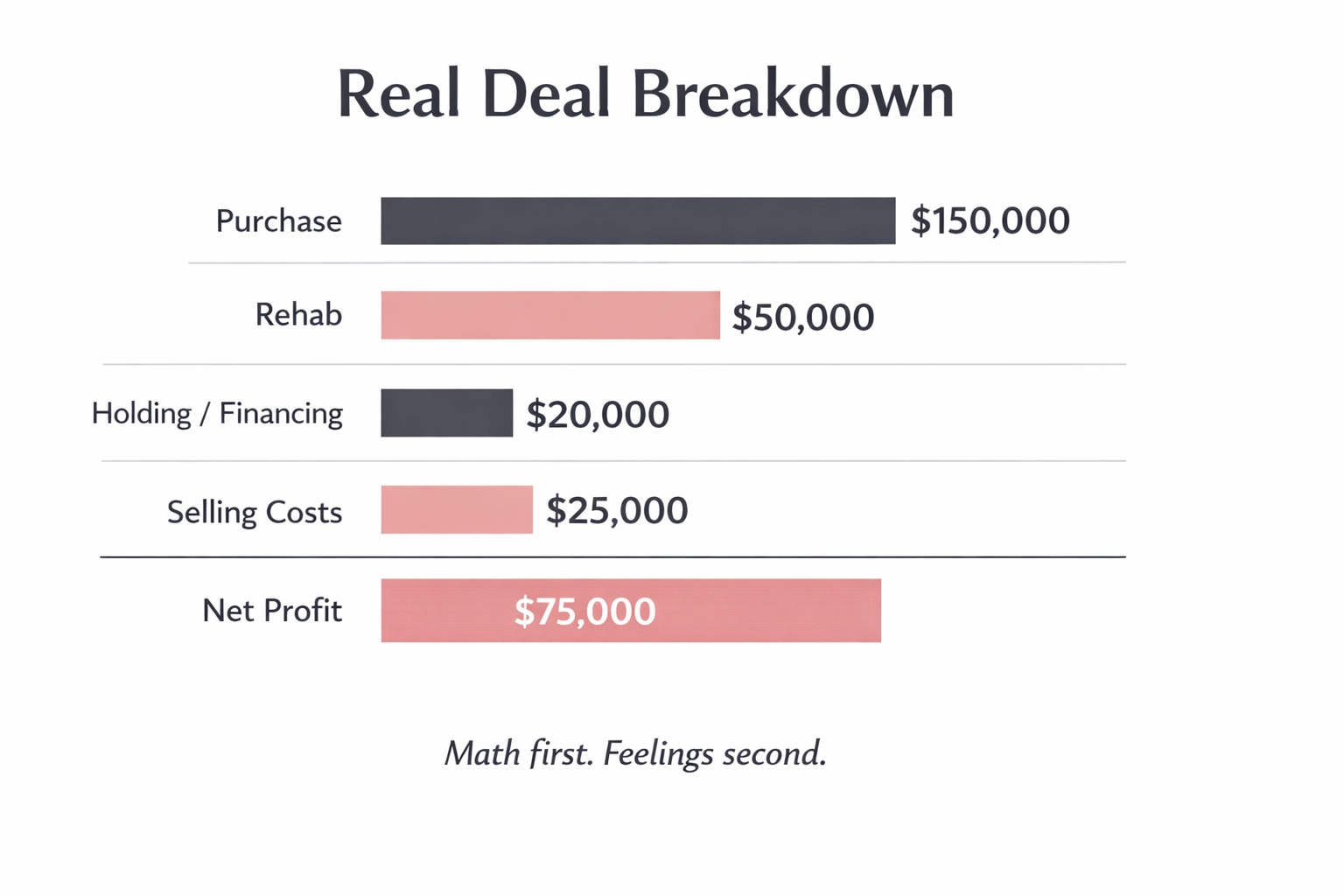
    Here’s the clean way to see the logic of a protected margin—without turning this into a math lesson:

    Real Deal Breakdown chart showing purchase, rehab, holding/financing, selling costs, and net profit

    That’s why “mythical profit” is such a trap. A deal can look fine at a glance, but once real-life costs step on the stage, the margin tells the truth. And when the margin is thin, every delay turns into stress, and every surprise turns into a financial decision you didn’t plan for.

    Takeaway: The goal isn’t to become a spreadsheet wizard overnight. The goal is to understand why margins collapse—so you stop buying deals that only work in perfect conditions.

    Chapter 5: The Core Principle

    If you take nothing else from this, remember this phrase: You don’t lose money when you sell; you lose it when you buy wrong.

    By the time you put a "For Sale" sign in the yard, your fate is already sealed. The profit was either baked into the deal on day one, or it wasn't. Having a Buy Box helps ensure you only say "yes" to deals where the profit is protected from the start.

    Takeaway: The buy is where you win (or lose). Profit Protector thinking starts at the offer—because that’s where your margin gets decided.

    Chapter 6: What a Buy Box Actually Is

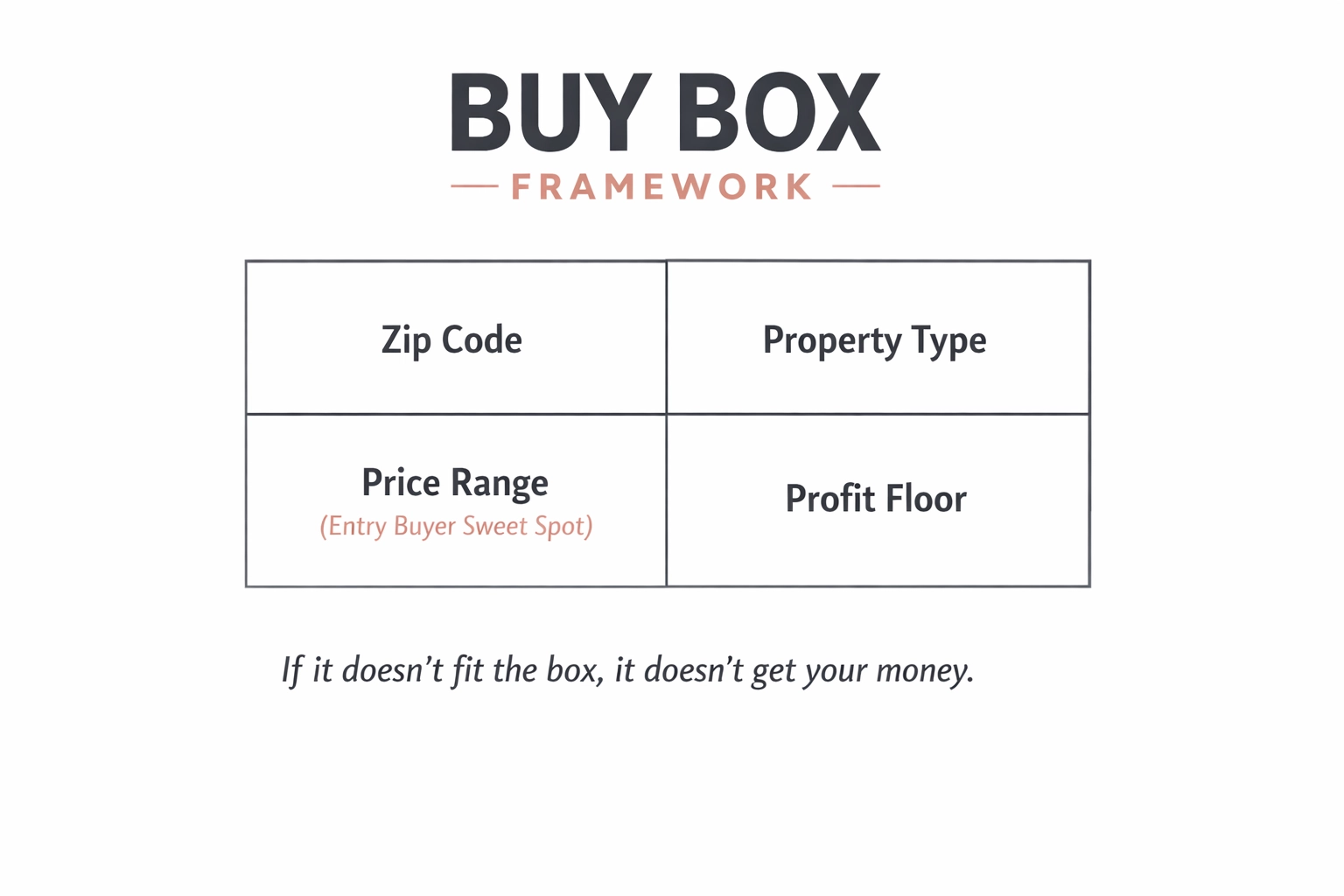
    Your Buy Box is your filter. It’s the “this is what we buy” definition you decide before the adrenaline hits. And it’s the fastest way I know to build Market Immunity—because you’re not getting yanked around by every new listing.

    Here’s the polished-but-real version of what you’re defining:

    Buy Box Framework visual with Zip Code, Property Type, Price Range, and Profit Floor

    Buy Box Checklist

    If you can’t answer these quickly, you’re not ready to buy yet—and that’s not shade, that’s protection.

    • Zip Code(s): Where you’re willing to compete and manage a project
    • Property Type: The kind of house you can confidently renovate and resell
    • Price Range: The “entry buyer” sweet spot your market actually supports
    • Profit Floor: The minimum that makes the risk, time, and stress worth it

    This is how you stop being “available for any deal” and start operating with Investor Authority—because now the deal has to impress you.

    Chapter 7: Why Markets Behave Differently

    Real estate is hyper-local. I’ve seen properties three minutes apart with the exact same layout and renovation level, where one sells in ten days and the other sits for two months. Why? Because one was on the "right" side of a major road or within a specific school district boundary.

    Without a Buy Box, you’re just guessing based on proximity. With one, you develop the local knowledge that allows you to spot a trap before you step in it.

    Side-by-side comparison of renovated houses demonstrating local market knowledge and a defined buy box. A side-by-side comparison of two seemingly identical houses with different market outcomes

    Chapter 8: The Architecture of a Professional Buy Box

    Let’s keep this out of “homework mode” and put it where it belongs: in Investor Authority.

    A Buy Box isn’t a cute checklist. It’s the architecture that holds up your decision-making when the market gets loud. This is the framework professional investors use to qualify opportunities—so they can move decisively on the right deals and ignore the rest without second-guessing.

    Here’s what a real Buy Box is designed to do:

    • Create Clarity: It reduces decision fatigue. You’re not evaluating every house—you’re qualifying the few that fit your business model.
    • Create Consistency: Repetition builds skill. When you stay in a defined lane (certain zip codes, certain property types), your pricing instincts sharpen and your project expectations get more realistic.
    • Create Risk Boundaries: A disciplined investor isn’t trying to “prove they can do anything.” She’s trying to protect profit and avoid projects that quietly drain time, cash, and confidence.
    • Create a Clean Exit: Investors with Market Immunity think about the end-buyer and neighborhood ceiling before they fall in love with finishes. A Buy Box keeps the exit strategy in the driver’s seat.

    In other words, your Buy Box is not a limitation—it’s a professional standard. It’s you choosing to operate like a Profit Protector, even when the market tries to tempt you into “just this once.”

    Takeaway: A strong Buy Box is a system for saying “yes” with confidence—and “no” without regret.

    Chapter 9: Common Mistakes to Avoid

    Most beginners don’t lose because they’re lazy. They lose because they’re unprotected—moving without a system, without a filter, and without experienced eyes on the deal.

    These are the traps I see most often, and more importantly, what they cost:

    • Copying Others: You inherit someone else’s risk tolerance, funding situation, and exit strategy—and then act shocked when the deal fits their business, not yours.
    • Emotional Buying (Homeowner Energy): You buy “potential,” then pay for it in change orders, timeline creep, and decisions made under stress.
    • The "One-Off" Trap: You buy the nicest house on the wrong block (or the weirdest house in a stable neighborhood). Then the market punishes you by limiting your buyer pool.
    • Entering Without Structure: You make decisions one property at a time, with no consistent standard. That’s how small mistakes stack into big losses—quietly, then all at once.

    This is why professional guidance matters. It’s not about hype—it’s about having a Profit Protector lens, a disciplined Buy Box, and the confidence to walk away before you get attached.

    Takeaway: The most expensive mistakes don’t look dramatic at first. They look like “it’ll probably be fine.” A system—and coaching—keeps “probably” out of your business.

    Conclusion: Final Thoughts + Next Steps

    The difference between a successful real estate entrepreneur and someone who loses their shirt is discipline. It’s the discipline to wait for the right opportunity—and the authority to say "no" to the wrong one without negotiating with your emotions.

    Stop reacting. Start deciding. Build your Buy Box, protect your margin, and operate with the authority you deserve.

    If you want to see this framework applied to live deals—how we evaluate risk, protect the profit, and avoid the “looks good on paper” traps—join us for the free live training this Saturday at 11:00 AM ET.

    Takeaway: Market Immunity isn’t luck. It’s structure—plus the confidence to stick to it when the market tries to rush you.

    Join the Free Webinar: This Saturday at 11:00 AM ET
    Register here: https://feminineflip.net/webinar


    Author Profile

    Meet Catricia

    Catricia Roberson is the Founder & Executive Director of The Feminine Flip. With years of experience in the trenches of real estate investing, she is dedicated to helping women transition from "scrolling" to "scaling" through structured education and high-level mentorship. Her mission is to empower women to build wealth with confidence, discipline, and authority.

    Connect with Catricia
    🔵 📸 💼 ▶️


    LEGAL DISCLAIMER: For educational purposes only. Not financial/legal advice. Results vary. Full terms at feminineflip.net/terms

  • Renovation Strategy: Mastering Deal Discipline to Protect Your Flip Profit

    Hero image: confident woman investor in a bright, modern renovated kitchen with a subtle blueprint overlay.

    Most people think renovation is where the money is made.

    It’s not.

    This is where most investors lose it.

    Because by the time you’re picking finishes, hiring contractors, and managing timelines… the deal has already been decided.

    Step 2 of the Feminine Flip Formula is Deal Discipline—because profit is made at the purchase, not the rehab.

    And if you buy wrong, the renovation becomes a rescue mission.

    The Mistake Most Beginners Make

    Beginners treat renovation like the main event.

    They focus on:

    • finishes
    • layouts
    • design

    But ignore the one thing that actually matters:

    👉 margin

    This is where Homeowner Energy shows up:

    • “I can make this work”
    • “It’s such a good deal”
    • “I don’t want to miss this”

    And that’s how people lose $20K–$50K on one deal.

    The Real Risk: Thin Deals

    A thin deal doesn’t need a disaster to fail.

    It needs:

    • one hidden issue
    • one delay
    • one contractor mistake
    • one emotional upgrade

    That’s it.

    Your profit is gone.

    That’s why Investor Authority matters.

    Because real investors don’t buy based on potential.

    They buy based on what the deal can survive.

    What Deal Discipline Actually Does

    Deal Discipline protects you from:

    • emotional decisions
    • bad numbers
    • unrealistic timelines
    • renovation drift

    It forces you to ask:

    • Does this deal still work if things go wrong?
    • Is there enough margin to absorb reality?
    • Am I buying a deal… or a problem?

    That’s how you become a Profit Protector.

    This Is Where Most People Get Stuck

    It’s not that they don’t want to invest.

    It’s that they don’t trust their decisions.

    So they:

    • overanalyze
    • hesitate
    • or jump into deals blindly

    And both cost money.

    The Difference Is Structure

    You don’t need to be a contractor.

    You don’t need years of experience.

    You need a system that tells you:
    👉 what to look for
    👉 what to avoid
    👉 and how to protect your money

    Start Here

    If you’re serious about learning how to analyze deals, protect your profit, and stop guessing your way through investing:

    👉 Join the Bootcamp + Community here:
    https://www.skool.com/the-feminine-flip-community-9167/about

    Inside, you’ll get:

    • the full framework
    • step-by-step guidance
    • tools and resources to get started

    Meet Catricia

    Catricia Roberson, Founder of The Feminine Flip

    Catricia Roberson is the Founder of The Feminine Flip. She helps women build Investor Authority so they can make confident, structured, and profitable real estate decisions without guesswork.

    Connect with Catricia
    🔵 Facebook | 📸 Instagram | 💼 LinkedIn | ▶️ YouTube

    Legal Disclaimer
    The information provided is for educational purposes only and does not constitute financial or investment advice.

  • Exit Strategy: Protecting Your Profit at the Finish Line

    Featured Image: Confident woman investor reviewing listing comps on a laptop at a modern desk, subtle pink accent, representing Market Immunity and a real estate exit strategy.

    A finished house doesn’t mean a finished deal.

    Because you don’t get paid when the rehab is done.

    You get paid when the property sells—and the money is back in your account with your margin protected.

    And this is where most investors lose control.

    The Mistake Most Investors Make

    They treat the exit like the easy part.

    They:

    • finish the rehab
    • list the property
    • and “see what happens”

    That’s not a strategy.

    That’s hope.

    And hope gets expensive.

    Where Profit Starts to Disappear

    This is where Homeowner Energy shows up again:

    • pricing based on emotion
    • waiting for the “right buyer”
    • resisting price adjustments
    • overestimating the market

    Meanwhile:

    • holding costs keep stacking
    • days on market increase
    • leverage shifts to the buyer

    And slowly… profit disappears.

    What Market Immunity Actually Means

    Market Immunity is not about predicting the market.

    It’s about being prepared for it.

    That’s Investor Authority:

    • knowing your numbers
    • understanding your timeline
    • making decisions based on margin, not ego

    Because the market will change.

    The question is:

    👉 will your deal survive it?

    The Real Risk: Time

    Every extra day costs you.

    Not just money—but control.

    Because the longer a property sits:

    • the more pressure you feel
    • the more reactive your decisions become
    • the more your profit gets negotiated away

    This is where most investors panic.

    And panic leads to bad decisions.

    The Truth About “Top Dollar”

    Everyone wants top dollar.

    But top dollar without speed is risk.

    Because:
    👉 certainty protects profit
    👉 speed protects margin

    And sometimes the best deal is the one that closes clean and on time.

    This Is Where Most People Get Stuck

    They don’t have a clear exit strategy.

    So they:

    • guess on pricing
    • react to the market
    • and adjust too late

    And by the time they figure it out…

    👉 the deal has already started slipping.

    The Difference Is Structure

    You don’t need a perfect market.

    You need a plan that works in a real one.

    A system that tells you:
    👉 how to price
    👉 how to move
    👉 how to protect your exit

    That’s what Market Immunity actually is.

    Start Here

    If you’re ready to stop guessing and start making structured, profitable real estate decisions:

    👉 Join the Bootcamp + Community here:
    https://www.skool.com/the-feminine-flip-community-9167/about

    Inside, you’ll get the full system, tools, and guidance to help you move with clarity and confidence.

    Meet Catricia

    Catricia Roberson is the Founder of The Feminine Flip. She helps women build Investor Authority so they can make confident, structured, and profitable real estate decisions without guesswork.

    Connect with Catricia
    🔵 Facebook | 📸 Instagram | 💼 LinkedIn | ▶️ YouTube

    Disclaimer:
    The information provided is for educational purposes only and does not constitute financial or investment advice.

  • Contractor Control: How to Manage Your Renovation Without the Stress

    E-book cover hero image: confident woman investor holding a tablet in a modern renovation setting.{: .featured-image }

    Contractor problems don’t start with a disaster.

    They start small.

    A delayed start.
    A vague invoice.
    A timeline that quietly slips.

    And before you realize it… your budget is doing all the work.

    The Real Problem Isn’t the Contractor

    Most new investors think:
    👉 “I just need a better contractor”

    That’s not the issue.

    The issue is a lack of Contractor Control.

    Because when there’s no structure:

    • timelines become optional
    • scope becomes flexible
    • payments get disconnected from progress

    And that’s how profit disappears.

    Where Most Investors Lose Control

    This is where Homeowner Energy shows up:

    • “I trust you—just handle it”
    • “I don’t want to be difficult”
    • “I’ll just go with the flow”

    That mindset works in your personal home.

    It does NOT work in an investment.

    Because in a flip:
    👉 unclear leadership = unclear outcomes

    What Investor Authority Looks Like

    You don’t need to know construction.

    You need to know how to lead the project.

    That’s Investor Authority:

    • clear expectations
    • defined scope
    • structured payments
    • accountability tied to progress

    You are not “working with” a contractor.

    👉 You are managing an investment.

    The Silent Profit Killer: Vague Accountability

    Most budget blowouts come from:

    • unclear scope
    • loose timelines
    • informal communication
    • paying before progress is complete

    And once things start slipping, people panic.

    They start:

    • approving extras
    • rushing decisions
    • paying just to “keep things moving”

    That’s not progress.

    👉 That’s profit loss.

    This Is Where Most People Get Stuck

    It’s not that they can’t find contractors.

    It’s that they don’t know how to control the project.

    So they:

    • over-trust
    • under-lead
    • and lose money trying to fix it later

    The Difference Is Structure

    You don’t need to be on-site every day.

    You need a system that tells you:
    👉 what to expect
    👉 what to enforce
    👉 and how to protect your money

    That’s what Contractor Control actually is.

    Start Here

    If you want to learn how to manage contractors without losing your budget, your timeline, or your confidence:

    👉 Join the Bootcamp + Community here:
    https://www.skool.com/the-feminine-flip-community-9167/about

    Inside, you’ll learn:

    • how to control your rehab
    • how to protect your margin
    • how to lead your projects with confidence

    Meet Catricia

    Catricia Roberson, Founder of The Feminine Flip

    Catricia Roberson is the Founder of The Feminine Flip. She helps women build Investor Authority so they can lead projects, protect profit, and make confident real estate decisions without guesswork.

    Connect with Catricia
    🔵 Facebook | 📸 Instagram | 💼 LinkedIn | ▶️ YouTube

    Disclaimer:
    The information provided is for educational purposes only and does not constitute financial or investment advice.

  • Can You Really Flip Houses with Bad Credit? Find Out How to Fund a House Flip Here

    ![FEATURED IMAGE]HERO image for Funding a House Flip

    The bad-credit myth is a wealth leak—here’s why it keeps women stuck

    Bad credit does not end investing careers. What ends them is accepting the bank’s definition of “ready.”

    When you’re told a low score disqualifies you from flipping houses, the message underneath is more damaging than the denial itself: wait on the sidelines until you’re “approved.” That belief traps ambitious women in Homeowner Energy—where every decision is filtered through personal worthiness, personal paperwork, and personal permission.

    House flipping is not a consumer purchase. It’s a financial project with an asset, a timeline, a risk profile, and a profit target. Projects are funded differently than people. The moment you shift into Investor Authority, the question changes from “Do they like my credit?” to “Is this a controlled opportunity with protected margins?”


    The real problem: you’re being evaluated like a borrower, not an operator

    Traditional lenders are designed to reduce uncertainty. They want predictable income, clean credit, long histories, and a slow process. That model isn’t “wrong”—it’s just not built for the speed and complexity of investment projects.

    If you approach flipping with Homeowner Energy, you unintentionally reinforce that model:

    • You over-focus on your personal score instead of the deal structure
    • You treat capital as “approval,” not as a business input to be negotiated
    • You hesitate to pursue opportunities until conditions feel perfect

    Investor Authority refuses that frame. An investor understands that a deal is a package: acquisition, rehab, carry costs, exit strategy, and downside protection. Funding is the tool that makes that package executable.

    This is why women with mediocre credit still close projects: they don’t rely on one lane. They build credibility through structure.


    The highest risk isn’t rejection—it’s stagnation

    Bad credit becomes dangerous when it turns into delay.

    Stagnation has a real price tag in real estate:

    • Equity loss: the best deals are bought by the people willing to move first
    • Experience loss: the learning curve doesn’t reward intention; it rewards execution
    • Network loss: lenders, contractors, agents, and partners trust operators in motion
    • Confidence loss: every month on the sidelines strengthens the story that you “can’t”

    And the market doesn’t pause while you wait for a score to recover. Neighborhoods shift. Inventory cycles. Interest rates move. Meanwhile, your future portfolio stays imaginary.

    That’s not a credit problem. That’s a strategy problem.


    Investor Authority: what serious funding sources actually want to see

    When investors talk about funding, they’re not looking for someone “deserving.” They’re looking for someone who thinks like a Profit Protector—a decision-maker who can defend the numbers and manage the project.

    Investor Authority shows up in professional signals:

    Clear deal logic (not vibes)

    You can articulate why the property works, where the margin comes from, and what assumptions you refuse to make.

    Downside awareness (not optimism)

    You acknowledge the friction points—permits, labor delays, materials inflation, appraisal risk—and you still show how the deal survives reality.

    Exit clarity (not hope)

    You’re not relying on a single outcome. You know what the primary exit is and what happens if the market softens.

    That posture changes everything. It’s how you get taken seriously—regardless of whether your credit is pristine.


    Creative funding is a system—build a capital stack that protects you

    Creative funding is not a last-minute scramble. High-level operators treat it as a system: a capital stack designed to keep the project funded while protecting profit, timeline, and control.

    A strong stack creates Market Immunity because you aren’t dependent on one institution’s definition of “acceptable.” When one lane tightens, you don’t stop—you restructure.

    Without giving a step-by-step playbook, here’s the professional framing:

    Asset-based capital

    Funding that centers the property and the plan. The asset is the anchor, and the underwriting leans heavily on the deal’s margin and risk controls—not just your score.

    Relationship-based capital

    Private capital and investor relationships that fund operators with clear standards. The credibility comes from your ability to present a controlled opportunity and execute with discipline.

    Strategic alliances

    Joint ventures and partnerships where strengths are combined by design—someone may bring capital or credit profile while you bring Investor Authority: sourcing, managing, budgeting, and exits.

    This is where most beginners get it wrong: they think funding is “finding money.” A Profit Protector knows funding is structuring capital so the deal remains profitable under pressure.


    Profit Protector standards: the rules that keep bad-credit funding from becoming expensive mistakes

    Bad-credit myths push women into two extremes: waiting forever or taking reckless money.

    Profit Protector standards keep you out of both traps. They force you to evaluate funding by what it does to the project, not by how good it feels to “get a yes.”

    Ask the questions operators ask:

    • Does this funding lane preserve enough margin after interest, fees, and carry costs?
    • Does it match the deal’s timeline—or will it create pressure that forces bad decisions?
    • Does it keep you in control of the rehab, the contractor, and the exit?
    • Does it reduce risk—or simply relocate it onto you?

    This is how Investor Authority creates Market Immunity: you stop being grateful for access and start being disciplined about terms.


    Bottom line: stop trying to qualify as a homeowner and start operating as an investor

    If you keep playing by homeowner rules, you’ll keep getting homeowner outcomes: slow timelines, limited options, and permission-based progress.

    Investor Authority is the pivot. It’s the moment you decide that your credit score is not the central metric of your investing future. Your structure is.

    The Feminine Flip Formula exists to train that pivot—how to evaluate funding lanes, build credibility, protect margins, and move through the market with confidence instead of hesitation.


    Meet Catricia

    Catricia Roberson is the Founder and Executive Director of The Feminine Flip™. With an MBA and years of high-stakes real estate experience, she has dedicated her career to helping women transition from spectators to high-level investors. Through her proprietary Feminine Flip Formula, Catricia teaches women how to master the Profit Protector mindset, build Investor Authority, and achieve Market Immunity in any economic climate. Her mission is to close the wealth gap by empowering women to take control of their financial destinies through educated, strategic real estate investing.

    Connect with Catricia:
    🔵 📸 💼 ▶️


    Disclaimer:
    The Feminine Flip™ provides real estate education; always consult a professional before investing.


    Comment 'BOOTCAMP' to join our next intake and learn the full Feminine Flip Formula.

  • Exit Strategy & Market Immunity

    Cover Image: professional woman investor standing confidently in front of a beautiful finished home

    Editor’s Note

    The final phase of any project is where the most dangerous trap lies: finish-line fatigue. After weeks or months of managing contractors and navigating the messy middle of a renovation, many investors lose their Investor Authority right when the stakes reach their peak. They stop being the Profit Protector and start acting like a tired homeowner who just wants it over with.

    This volume is about the pivot from the dust to the check. In the Feminine Flip Formula, we don’t just “hope” to sell; we engineer an exit insulated from market volatility. We call this Market Immunity—the transition from acquisition to disposition where projected profit becomes realized wealth.

    Table of Contents

    • Introduction: The Final Pivot
    • Chapter 1: The Final Transition (Acquisition to Disposition)
    • Chapter 2: Market Immunity: The Built-In Protection
    • Chapter 3: The Staging Standard
    • Chapter 4: Pricing for Velocity
    • Chapter 5: The Inspection & Appraisal Hurdles
    • Chapter 6: Multiple Exit Paths
    • Chapter 7: The “Sold” Mindset
    • Chapter 8: Finalizing the Numbers
    • Chapter 9: Building Momentum for the Next One
    • Conclusion: Final Thoughts & The Next Move

    Introduction: The Final Pivot

    The renovation is complete. The dust has settled. Now comes the most critical part of the process: converting the asset back into capital.

    Many investors think the hard part is over once the last contractor leaves. They are wrong. The hard part is ensuring you actually capture the profit you worked so hard to protect.

    To do that, you must shift from an execution mindset to a disposition mindset. This is where Homeowner Energy becomes expensive—leading to rushed decisions, weak negotiations, and poor pricing.

    Chapter 1: The Final Transition (Acquisition to Disposition)

    Acquisition is about the buy. Disposition is about the exit.

    You are no longer managing a project—you are managing a sale. Every decision now must serve the buyer and the market.

    If it doesn’t support value, it doesn’t belong.

    Takeaway: Exit strategy is a leadership phase, not an afterthought.

    Chapter 2: Market Immunity: The Built-In Protection

    Market Immunity is built, not found.

    It comes from:

    • buying right
    • renovating to the neighborhood standard
    • maintaining discipline

    This creates a buffer that protects your deal when conditions shift.

    Takeaway: Your exit is protected at acquisition.

    Chapter 3: The Staging Standard

    Now is when you trigger emotion—in your buyer.

    Beautifully staged living room in a finished flip

    Staging is not decoration. It is positioning.

    You are selling a lifestyle, not just a house.

    Takeaway: Presentation influences price.

    Chapter 4: Pricing for Velocity

    Ego kills deals.

    The market does not reward effort—it rewards value.

    A fast, clean sale often protects more profit than chasing a higher number over time.

    Takeaway: Price is strategy, not emotion.

    Chapter 5: The Inspection & Appraisal Hurdles

    You are not done at contract.

    Inspection and appraisal are where deals fall apart—or get renegotiated.

    Preparation and clarity protect your position.

    Takeaway: Stay structured, not emotional.

    Chapter 6: Multiple Exit Paths

    Strong deals have options:

    • sell
    • refinance
    • rent

    If you only have one exit, you have risk.

    Takeaway: Flexibility protects profit.

    Chapter 7: The “Sold” Mindset

    Detach.

    This is no longer your project—it is an asset.

    Emotional attachment leads to poor decisions. Controlled detachment leads to profit.

    Takeaway: Detachment is a Profit Protector skill.

    Chapter 8: Finalizing the Numbers

    The final number tells the truth.

    Review:

    • budget vs actual
    • timeline vs reality
    • decisions vs outcomes

    This is how you improve your next deal.

    Chapter 9: Building Momentum for the Next One

    The goal is not one deal.

    It is repeatable results.

    Investor smiling next to a SOLD sign

    Momentum builds when structure is consistent.

    Conclusion: Final Thoughts & The Next Move

    The exit determines whether your work turns into profit—or pressure.

    To win consistently, you must operate with:

    • Investor Authority
    • Profit Protector thinking
    • Market Immunity

    Next Step

    Join the free webinar to see how this system is applied to real deals:

    👉 https://feminineflip.net/webinar

    Or if you’re ready for direct guidance:

    👉 https://feminineflip.net/book-now

    Author Profile

    Catricia Roberson

    Catricia Roberson, Founder & Executive Director of The Feminine Flip, is a real estate educator and house-flipping mentor who helps women build Investor Authority so they can protect profit, manage contractors with confidence, and execute deals with structure—even without a large budget, perfect credit, or construction experience.

    Connect with Catricia:
    🔵 📸 💼 ▶️

    Disclaimer

    LEGAL DISCLAIMER: For educational purposes only. Not financial/legal advice. Results vary. Full terms at feminineflip.net/terms

  • Confident woman investor reviewing listing comps on a laptop at a modern desk, subtle pink accent, representing Market Immunity and a real estate exit strategy.

    A finished house doesn’t mean a finished deal.

    Because you don’t get paid when the rehab is done.

    You get paid when the property sells—and the money is back in your account with your margin protected.

    And this is where most investors lose control.

    The Mistake Most Investors Make

    They treat the exit like the easy part.

    They:

    • finish the rehab
    • list the property
    • and “see what happens”

    That’s not a strategy.

    That’s hope.

    And hope gets expensive.

    Where Profit Starts to Disappear

    This is where Homeowner Energy shows up again:

    • pricing based on emotion
    • waiting for the “right buyer”
    • resisting price adjustments
    • overestimating the market

    Meanwhile:

    • holding costs keep stacking
    • days on market increase
    • leverage shifts to the buyer

    And slowly… profit disappears.

    What Market Immunity Actually Means

    Market Immunity is not about predicting the market.

    It’s about being prepared for it.

    That’s Investor Authority:

    • knowing your numbers
    • understanding your timeline
    • making decisions based on margin, not ego

    Because the market will change.

    The question is:

    👉 will your deal survive it?

    The Real Risk: Time

    Every extra day costs you.

    Not just money—but control.

    Because the longer a property sits:

    • the more pressure you feel
    • the more reactive your decisions become
    • the more your profit gets negotiated away

    This is where most investors panic.

    And panic leads to bad decisions.

    The Truth About “Top Dollar”

    Everyone wants top dollar.

    But top dollar without speed is risk.

    Because:
    👉 certainty protects profit
    👉 speed protects margin

    And sometimes the best deal is the one that closes clean and on time.

    This Is Where Most People Get Stuck

    They don’t have a clear exit strategy.

    So they:

    • guess on pricing
    • react to the market
    • and adjust too late

    And by the time they figure it out…

    👉 the deal has already started slipping.

    The Difference Is Structure

    You don’t need a perfect market.

    You need a plan that works in a real one.

    A system that tells you:
    👉 how to price
    👉 how to move
    👉 how to protect your exit

    That’s what Market Immunity actually is.

    Start Here

    If you’re ready to stop guessing and start making structured, profitable real estate decisions:

    👉 Join the Bootcamp + Community here:
    https://www.skool.com/the-feminine-flip-community-9167/about

    Inside, you’ll get the full system, tools, and guidance to help you move with clarity and confidence.

    Meet Catricia

    Catricia Roberson is the Founder of The Feminine Flip. She helps women build Investor Authority so they can make confident, structured, and profitable real estate decisions without guesswork.

    Connect with Catricia
    🔵 Facebook | 📸 Instagram | 💼 LinkedIn | ▶️ YouTube

    Disclaimer:
    The information provided is for educational purposes only and does not constitute financial or investment advice.

  • E-book cover hero image: confident woman investor holding a tablet in a modern renovation setting.

    Contractor problems don’t start with a disaster.

    They start small.

    A delayed start.
    A vague invoice.
    A timeline that quietly slips.

    And before you realize it… your budget is doing all the work.

    The Real Problem Isn’t the Contractor

    Most new investors think:
    👉 “I just need a better contractor”

    That’s not the issue.

    The issue is a lack of Contractor Control.

    Because when there’s no structure:

    • timelines become optional
    • scope becomes flexible
    • payments get disconnected from progress

    And that’s how profit disappears.

    Where Most Investors Lose Control

    This is where Homeowner Energy shows up:

    • “I trust you—just handle it”
    • “I don’t want to be difficult”
    • “I’ll just go with the flow”

    That mindset works in your personal home.

    It does NOT work in an investment.

    Because in a flip:
    👉 unclear leadership = unclear outcomes

    What Investor Authority Looks Like

    You don’t need to know construction.

    You need to know how to lead the project.

    That’s Investor Authority:

    • clear expectations
    • defined scope
    • structured payments
    • accountability tied to progress

    You are not “working with” a contractor.

    👉 You are managing an investment.

    The Silent Profit Killer: Vague Accountability

    Most budget blowouts come from:

    • unclear scope
    • loose timelines
    • informal communication
    • paying before progress is complete

    And once things start slipping, people panic.

    They start:

    • approving extras
    • rushing decisions
    • paying just to “keep things moving”

    That’s not progress.

    👉 That’s profit loss.

    This Is Where Most People Get Stuck

    It’s not that they can’t find contractors.

    It’s that they don’t know how to control the project.

    So they:

    • over-trust
    • under-lead
    • and lose money trying to fix it later

    The Difference Is Structure

    You don’t need to be on-site every day.

    You need a system that tells you:
    👉 what to expect
    👉 what to enforce
    👉 and how to protect your money

    That’s what Contractor Control actually is.

    Start Here

    If you want to learn how to manage contractors without losing your budget, your timeline, or your confidence:

    👉 Join the Bootcamp + Community here:
    https://www.skool.com/the-feminine-flip-community-9167/about

    Inside, you’ll learn:

    • how to control your rehab
    • how to protect your margin
    • how to lead your projects with confidence

    Meet Catricia

    Catricia Roberson, Founder of The Feminine Flip

    Catricia Roberson is the Founder of The Feminine Flip. She helps women build Investor Authority so they can lead projects, protect profit, and make confident real estate decisions without guesswork.

    Connect with Catricia
    🔵 Facebook | 📸 Instagram | 💼 LinkedIn | ▶️ YouTube

    Disclaimer:
    The information provided is for educational purposes only and does not constitute financial or investment advice.