Cover Page

Editor’s Note: Welcome to the Guide
This is a strategic Feminine Flip framework designed to help you master the investor mindset. It’s a deep-dive into the core strategy behind the Feminine Flip Formula—so you can think like a Profit Protector, operate with Investor Authority, and build Market Immunity before you ever put a deal under contract.
Table of Contents
- Introduction: A Letter From the Author
- Chapter 1: The $10,000 View
- Chapter 2: Beginner vs. Investor Mindset
- Chapter 3: The Reality of Today’s Market
- Chapter 4: The "Mythical Profit" Breakdown
- Chapter 5: The Core Principle
- Chapter 6: What a Buy Box Actually Is
- Chapter 7: Why Markets Behave Differently
- Chapter 8: How to Build Your Buy Box
- Chapter 9: Common Mistakes to Avoid
- Conclusion: Final Thoughts + Next Steps
- Author Profile
Introduction: A Letter From the Author
I can usually tell within about three minutes of a conversation who is about to move like a seasoned pro and who is about to learn a very expensive, very painful lesson.
It usually starts when a beginner tells me, “I found this great house on Zillow. I think it could be a really good deal.” When I ask them what their Buy Box is, there’s a long, awkward pause.
That pause is the sound of money leaking out of a future bank account.
In real estate investing, "guessing" is just a fancy word for "gambling with your life savings." If you want to move from being a hobbyist to operating with true Investor Authority, you have to stop reacting to the market and start deciding what you want from it before you ever log onto an app.
Takeaway: Investor Authority isn’t a vibe. It’s a decision you make in advance—so your money stops getting dragged around by your emotions.
Chapter 1: The $10,000 View
I call this the "$10,000 View." Before an experienced investor ever looks at a single property, they already know exactly what they are willing to buy. Their decision isn't based on what happens to show up in their inbox that morning; it’s based on what works for their business model.
Most beginners do the exact opposite. They browse listings, see a house with "potential" (a dangerous word in this business), and then try to perform mental gymnastics to make the numbers fit. They are reacting. Real Investor Authority is about deciding in advance. It’s about having a filter so strong that 95% of the "deals" out there don't even make it past your first glance.
Chapter 2: Beginner vs. Investor Mindset
We’ve all been there, the late-night Zillow spiral. You see a fixer-upper with a cute porch and suddenly you’re picking out backsplash tile and imagining the "For Sale" sign in the yard. This is Homeowner Energy—and it’s not a character flaw. It’s just what happens when you look at a house emotionally, not analytically.
But Investor Authority is the moment you can appreciate the porch… and still say, “Yeah, no.”
An investor doesn’t see a "cute porch." An investor sees a specific asset class, in a specific zip code, with a realistic renovation scope—and a margin that can survive the dust, the delays, and the random stuff that always pops up behind the walls.
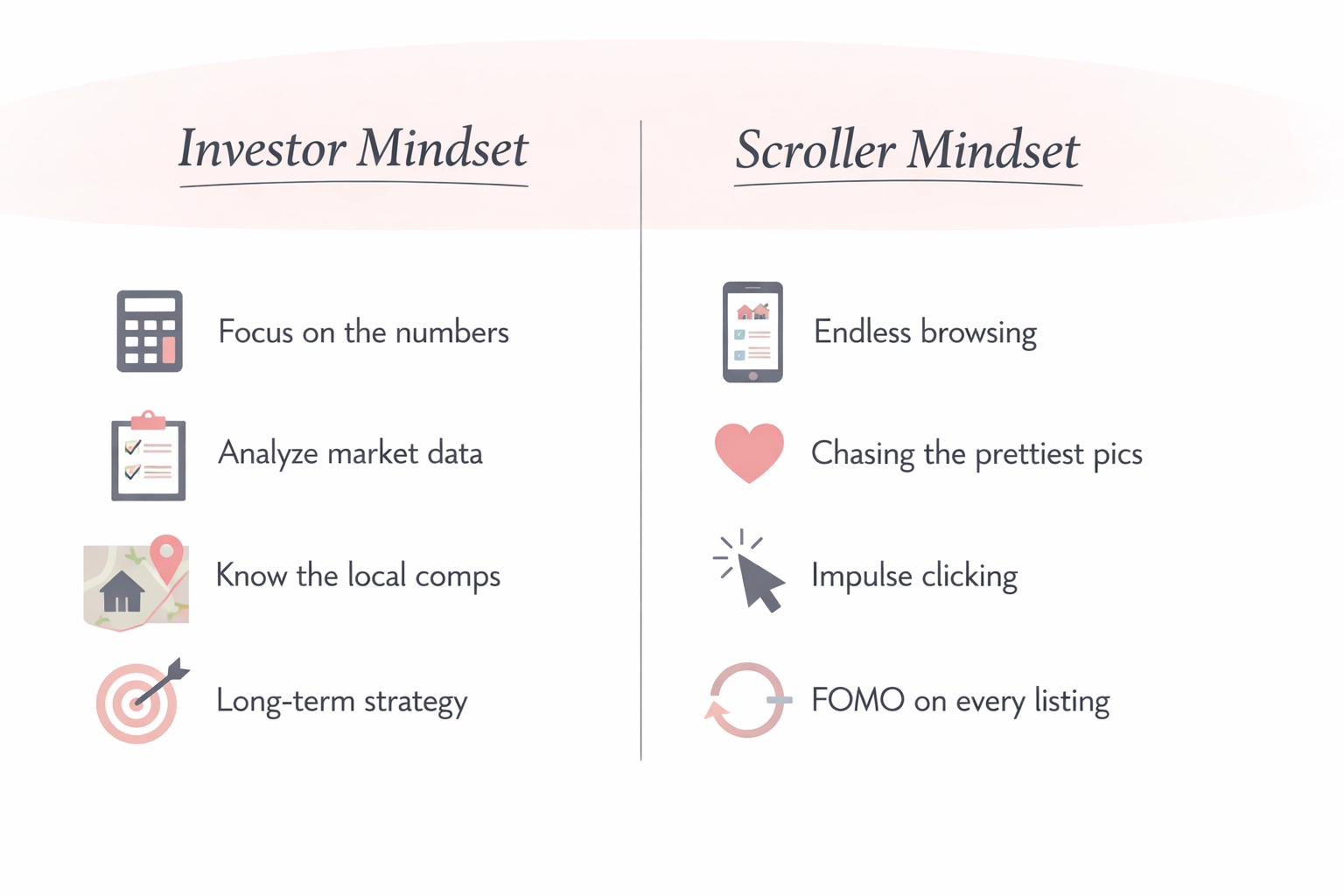
"Beginners chase deals. Investors disqualify them."
When you have a defined Buy Box, you stop being a "searcher" and start being an "analyzer." You aren't looking for a reason to buy; you are looking for a reason to say no. That shift is a Profit Protector move—because it keeps your capital out of emotional decisions and inside disciplined ones.
Chapter 3: The Reality of Today’s Market
Let’s get real about the market we’re standing in right now. This isn't 2021. You’re dealing with higher borrowing costs than we’ve seen in years. Insurance premiums are skyrocketing in many regions, and property taxes are adjusting upward.
In many zip codes, homes aren't flying off the shelf in 48 hours anymore. They are sitting for 30, 45, or even 60 days. This means your margin for error has shrunk. A deal that "kind of works" actually doesn't work at all. To achieve Market Immunity, you need to understand that your profit isn't just "sale price minus purchase price." It’s the battle against holding costs and market fatigue.

Chapter 4: The "Mythical Profit" Breakdown
I recently had a student send me a deal she was excited about. On the surface, it looked like a winner:
- Purchase Price: $200,000
- Estimated Rehab: $40,000
- Expected Resale: $300,000
She saw a $60,000 profit and started mentally spending that check. (We’ve all done it. That’s human.) But Investor Authority is the discipline to pause long enough to respect what the deal is really asking from you.
Here’s what I want you to understand at a high level: those “extra” costs aren’t punishment—they’re the real-world price of running a project.
- Financing costs exist because money has a cost. Even when you’re using a lender to move faster, that speed comes with a monthly clock attached.
- Holding costs exist because the property is alive while you own it—utilities, insurance, taxes, lawn, trash, security. The house doesn’t care that your contractor is behind.
- Transaction costs exist because buying and selling real estate has toll booths—agents, title, escrow, recording, fees. That’s part of the business.
- Comps matter because the market is the final judge. Your after-photos might be gorgeous, but your buyer pool and neighborhood ceiling decide what you can actually get paid.
So instead of getting stuck in “how do I calculate every line item,” think like a Profit Protector: How protected is my margin against time, surprises, and market mood?
Here’s the clean way to see the logic of a protected margin—without turning this into a math lesson:
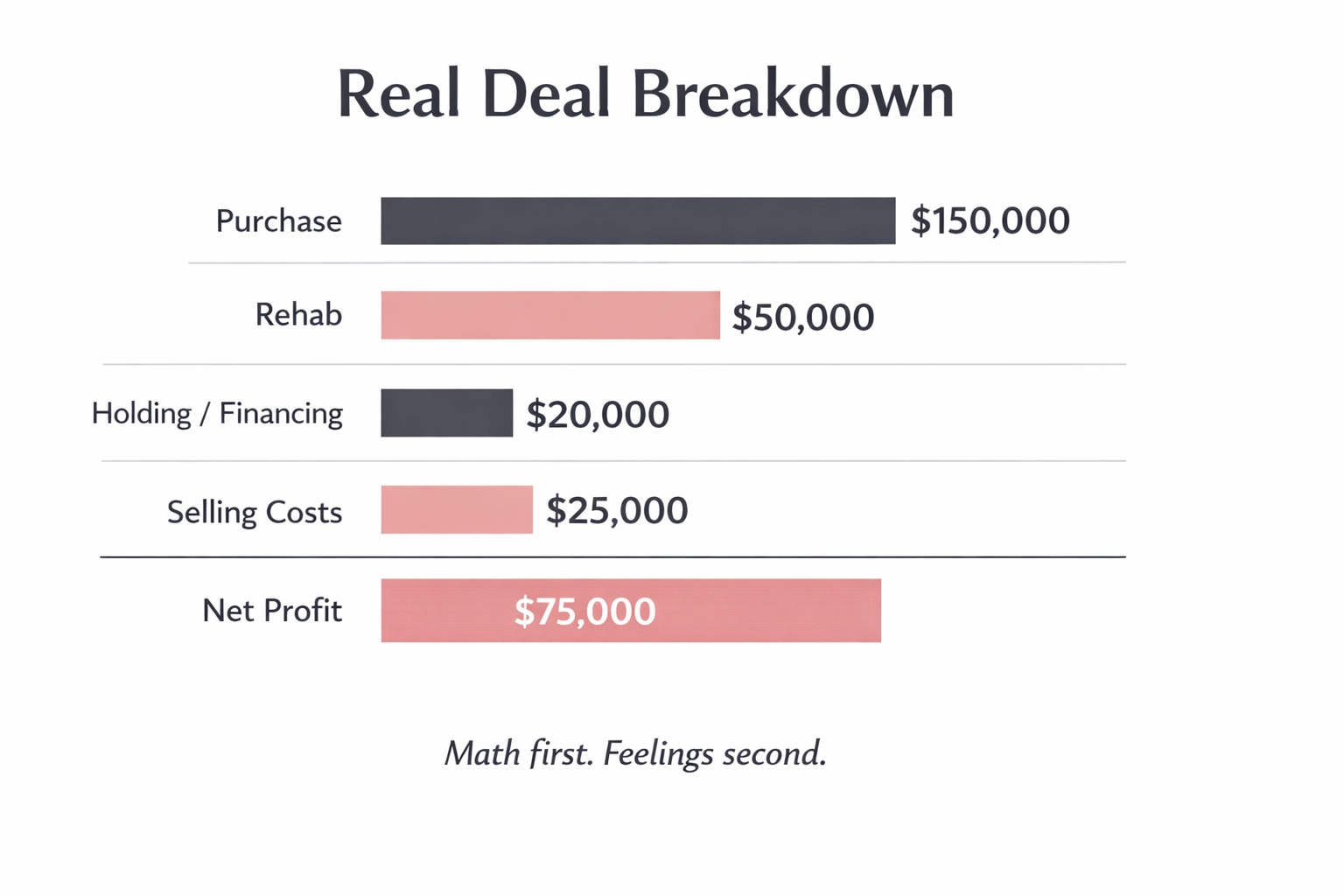
That’s why “mythical profit” is such a trap. A deal can look fine at a glance, but once real-life costs step on the stage, the margin tells the truth. And when the margin is thin, every delay turns into stress, and every surprise turns into a financial decision you didn’t plan for.
Takeaway: The goal isn’t to become a spreadsheet wizard overnight. The goal is to understand why margins collapse—so you stop buying deals that only work in perfect conditions.
Chapter 5: The Core Principle
If you take nothing else from this, remember this phrase: You don’t lose money when you sell; you lose it when you buy wrong.
By the time you put a "For Sale" sign in the yard, your fate is already sealed. The profit was either baked into the deal on day one, or it wasn't. Having a Buy Box helps ensure you only say "yes" to deals where the profit is protected from the start.
Takeaway: The buy is where you win (or lose). Profit Protector thinking starts at the offer—because that’s where your margin gets decided.
Chapter 6: What a Buy Box Actually Is
Your Buy Box is your filter. It’s the “this is what we buy” definition you decide before the adrenaline hits. And it’s the fastest way I know to build Market Immunity—because you’re not getting yanked around by every new listing.
Here’s the polished-but-real version of what you’re defining:
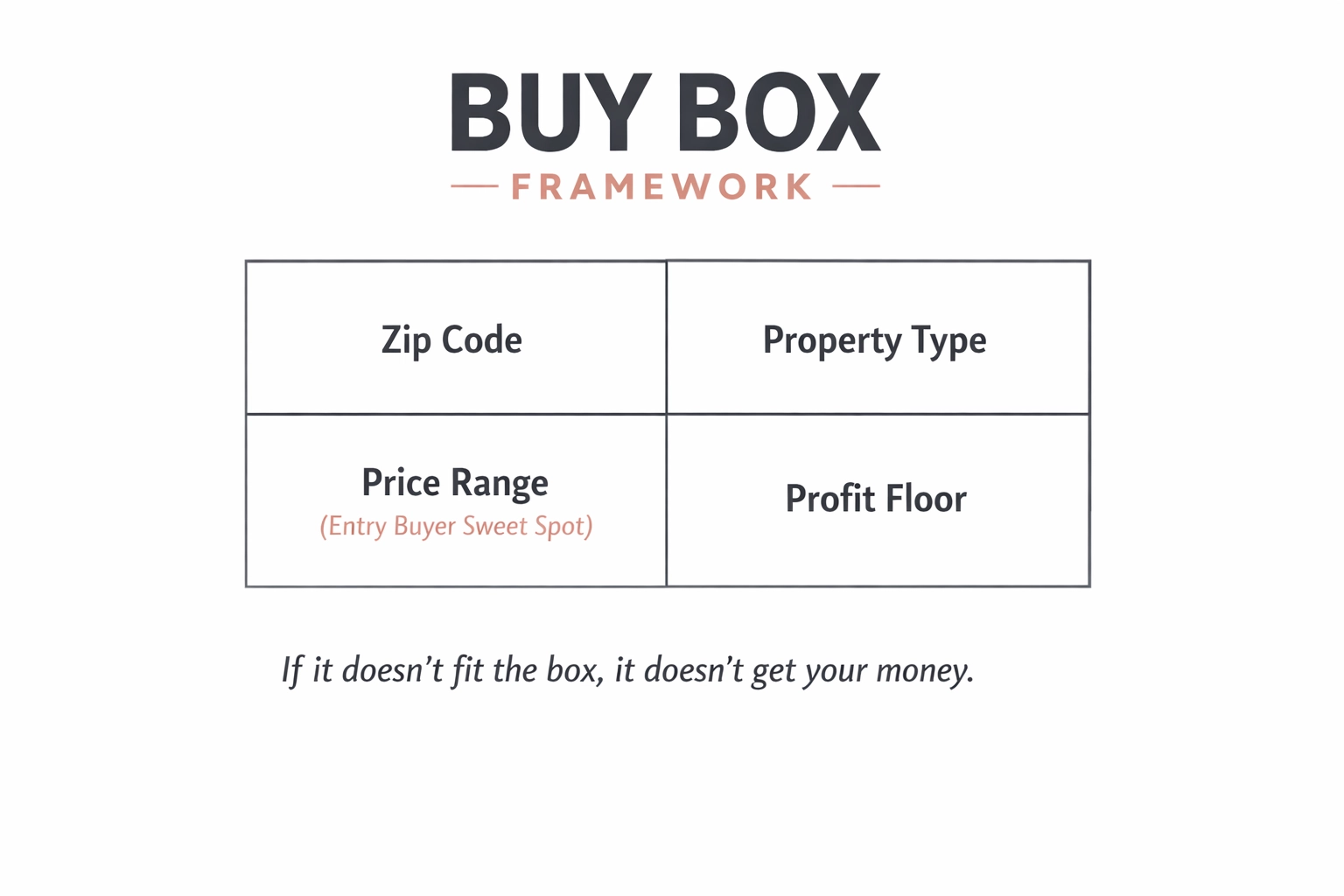
Buy Box Checklist
If you can’t answer these quickly, you’re not ready to buy yet—and that’s not shade, that’s protection.
- Zip Code(s): Where you’re willing to compete and manage a project
- Property Type: The kind of house you can confidently renovate and resell
- Price Range: The “entry buyer” sweet spot your market actually supports
- Profit Floor: The minimum that makes the risk, time, and stress worth it
This is how you stop being “available for any deal” and start operating with Investor Authority—because now the deal has to impress you.
Chapter 7: Why Markets Behave Differently
Real estate is hyper-local. I’ve seen properties three minutes apart with the exact same layout and renovation level, where one sells in ten days and the other sits for two months. Why? Because one was on the "right" side of a major road or within a specific school district boundary.
Without a Buy Box, you’re just guessing based on proximity. With one, you develop the local knowledge that allows you to spot a trap before you step in it.

Chapter 8: The Architecture of a Professional Buy Box
Let’s keep this out of “homework mode” and put it where it belongs: in Investor Authority.
A Buy Box isn’t a cute checklist. It’s the architecture that holds up your decision-making when the market gets loud. This is the framework professional investors use to qualify opportunities—so they can move decisively on the right deals and ignore the rest without second-guessing.
Here’s what a real Buy Box is designed to do:
- Create Clarity: It reduces decision fatigue. You’re not evaluating every house—you’re qualifying the few that fit your business model.
- Create Consistency: Repetition builds skill. When you stay in a defined lane (certain zip codes, certain property types), your pricing instincts sharpen and your project expectations get more realistic.
- Create Risk Boundaries: A disciplined investor isn’t trying to “prove they can do anything.” She’s trying to protect profit and avoid projects that quietly drain time, cash, and confidence.
- Create a Clean Exit: Investors with Market Immunity think about the end-buyer and neighborhood ceiling before they fall in love with finishes. A Buy Box keeps the exit strategy in the driver’s seat.
In other words, your Buy Box is not a limitation—it’s a professional standard. It’s you choosing to operate like a Profit Protector, even when the market tries to tempt you into “just this once.”
Takeaway: A strong Buy Box is a system for saying “yes” with confidence—and “no” without regret.
Chapter 9: Common Mistakes to Avoid
Most beginners don’t lose because they’re lazy. They lose because they’re unprotected—moving without a system, without a filter, and without experienced eyes on the deal.
These are the traps I see most often, and more importantly, what they cost:
- Copying Others: You inherit someone else’s risk tolerance, funding situation, and exit strategy—and then act shocked when the deal fits their business, not yours.
- Emotional Buying (Homeowner Energy): You buy “potential,” then pay for it in change orders, timeline creep, and decisions made under stress.
- The "One-Off" Trap: You buy the nicest house on the wrong block (or the weirdest house in a stable neighborhood). Then the market punishes you by limiting your buyer pool.
- Entering Without Structure: You make decisions one property at a time, with no consistent standard. That’s how small mistakes stack into big losses—quietly, then all at once.
This is why professional guidance matters. It’s not about hype—it’s about having a Profit Protector lens, a disciplined Buy Box, and the confidence to walk away before you get attached.
Takeaway: The most expensive mistakes don’t look dramatic at first. They look like “it’ll probably be fine.” A system—and coaching—keeps “probably” out of your business.
Conclusion: Final Thoughts + Next Steps
The difference between a successful real estate entrepreneur and someone who loses their shirt is discipline. It’s the discipline to wait for the right opportunity—and the authority to say "no" to the wrong one without negotiating with your emotions.
Stop reacting. Start deciding. Build your Buy Box, protect your margin, and operate with the authority you deserve.
If you want to see this framework applied to live deals—how we evaluate risk, protect the profit, and avoid the “looks good on paper” traps—join us for the free live training this Saturday at 11:00 AM ET.
Takeaway: Market Immunity isn’t luck. It’s structure—plus the confidence to stick to it when the market tries to rush you.
Join the Free Webinar: This Saturday at 11:00 AM ET
Register here: https://feminineflip.net/webinar
Author Profile
Meet Catricia

Catricia Roberson is the Founder and Executive Director of The Feminine Flip. With years of experience in the trenches of real estate investing, she is dedicated to helping women transition from "scrolling" to "scaling" through structured education and high-level mentorship. Her mission is to empower women to build wealth with confidence, discipline, and authority.
Connect with Catricia
🔵 Facebook | 📸 Instagram | 💼 LinkedIn | ▶️ YouTube
Legal Disclaimer
The information provided in this blog post is for educational and informational purposes only and does not constitute financial, investment, or legal advice. Real estate investing involves significant risk, and past performance is not indicative of future results. Always consult with a licensed professional (such as an attorney, accountant, or financial advisor) before making any investment decisions. The Feminine Flip and its affiliates are not responsible for any financial losses incurred as a result of using the information provided.
Ready to take the next step?
Join us for the Free Webinar this Saturday at 11:00 AM ET: https://feminineflip.net/webinar
Leave a Reply